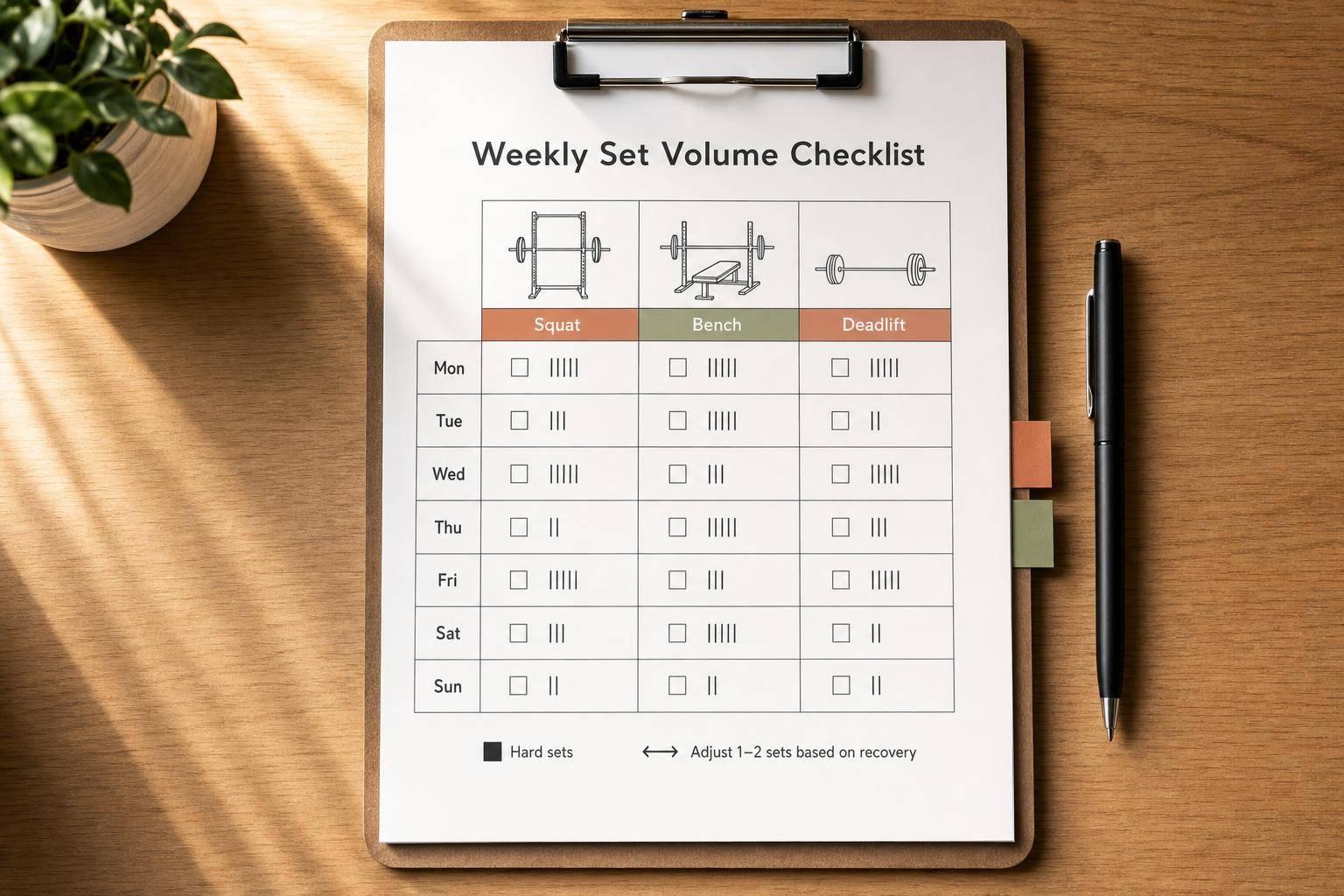
Weekly Set Volume Checklist for 3 Big Lifts
Most lifters don’t need more work. They need the right amount of work, spread across the week.
If I were auditing my squat, bench press, and deadlift volume, I’d check 5 things first:
- How often each lift shows up in 7 days
- How many hard sets I’m doing
- Whether variations should count toward that total
- Whether volume is bunched into one session
- Whether performance, soreness, sleep, and joint pain say I should hold, add, or cut sets
The article’s main point is simple: I’d count hard sets only, keep weekly volume in a recoverable range, and adjust by small amounts instead of guessing. For many early-intermediate lifters, that usually means around 6–10 squat sets, 8–14 bench sets, and 4–8 deadlift sets per week, with 3–5 hard sets per lift per session as a solid check.
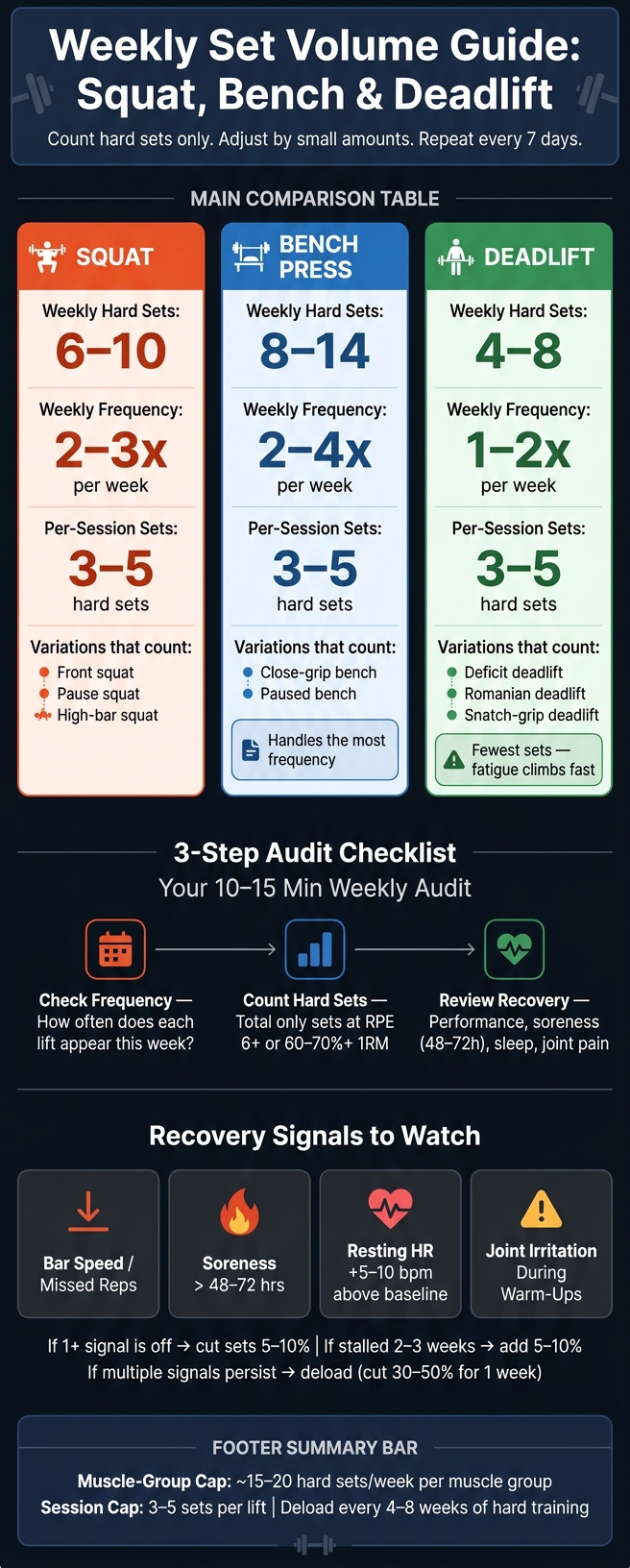
Weekly Set Volume Guide: Squat, Bench & Deadlift
How Many Weekly Sets Improve Muscle Strength | Dr. Andrew Huberman
Quick Comparison
| Lift | Weekly hard sets | Weekly frequency | Per-session check |
|---|---|---|---|
| Squat pattern | 6–10 | 2–3 times | 3–5 hard sets |
| Bench press pattern | 8–14 | 2–4 times | 3–5 hard sets |
| Deadlift pattern | 4–8 | 1–2 times | 3–5 hard sets |
A few points matter most. Deadlift usually needs the fewest sets because fatigue climbs fast. Bench can often handle more weekly work. And if progress stalls, I’d first look at frequency and recovery before I just pile on extra volume.
Bottom line: I’d run a 10–15 minute weekly audit, use hard sets as the main number, keep heavy work plus moderate volume in the plan, and change only 1–2 sets at a time unless recovery is clearly slipping.
Step 1: Check Weekly Frequency for Squat, Bench Press, and Deadlift
Count How Many Times Each Lift Appears in Your Week
After you set your weekly set targets, look at how often that work shows up during the week.
Go day by day through your training plan and mark each squat, bench, or deadlift pattern you perform. For most intermediate lifters, a solid starting point is squat 2–3 times, bench press 2–4 times, and deadlift 1–2 times per week.[5][7][8] Bench tends to handle the most frequency. Deadlift is usually the hardest lift to recover from because it taxes the lower back and hips more than the others.[5][6][9]
This matters for a simple reason: frequency helps you spread volume across the week. That usually means better practice and less pressure to cram all your hard work into one brutal session.
If a lift only appears once every 7 to 10 days and your progress has stalled, adding a second lower-fatigue exposure is often a smarter first step than piling more work into that one day.
Include Close Variations That Add Stress to the Same Pattern
You should also count loaded variations that hit the same movement pattern. A variation counts if it's done at about 60%–70% 1RM or RPE 6–8. Warm-up sets don't count. Hard sets do.[4][1]
Here’s a simple way to judge it:
| Lift Pattern | Variations That Count | Common Exclusions |
|---|---|---|
| Squat | Front squat, pause squat, high-bar squat | Leg extension |
| Bench press | Close-grip bench, paused bench | Chest fly |
| Deadlift | Deficit deadlift, Romanian deadlift, snatch-grip deadlift | Leg curl |
This is where variations help a lot. They let you get more exposure without turning every session into a max-effort grind.
For example, one heavy conventional deadlift day plus one moderate Romanian deadlift day gives you two deadlift-pattern exposures for the week while keeping fatigue in check. Just don't stack heavy variations on back-to-back days.
Once frequency is locked in, the next step is to count the hard sets those exposures produce.
Step 2: Count Weekly Hard Sets and Compare Them to Recoverable Ranges
Add Up Hard Sets for Each Main Lift
Now it’s time to total your hard sets. Count every hard set for the squat, bench press, and deadlift, along with the variations you’ve already grouped under each movement pattern.
| Lift | Starting Range (Hard Sets/Week) |
|---|---|
| Squat | 6–10 |
| Bench Press | 8–14 |
| Deadlift | 4–8 |
This is where recovery starts to matter. If you recover well, you may be able to sit near the top of the range. If recovery is shaky, the lower end usually makes more sense.
If you’re below the range and progress has stalled, add 2–3 sets during the week. If you’re above the range and performance is slipping or your joints hurt, cut 2–4 sets before you add anything else.[1]
If the total looks fine at first glance, don’t stop there. The next step is to check whether overlap between lifts is quietly driving your workload up.
Check Muscle-Group Volume So Overlap Does Not Hide Excess Work
Per-lift totals can look safe while the muscles doing the work are already overloaded. That’s the catch.
Squats and deadlifts both train the posterior chain, and bench work stacks on top of your other pressing work.[18][19] So even if each lift sits in a normal range, the shared muscles may still be doing too much.
After you total sets by lift, do a second pass by muscle group. For most non-advanced lifters, 15–20 hard sets per week for one muscle group is a useful upper limit.[2][10][11]
Here’s a simple example:
10 squat sets plus 8 deadlift sets puts the posterior chain at roughly 18 hard sets - even if neither lift looks excessive on its own.[18][19]
If soreness hangs around, your form starts to slip, or your joints get cranky, that’s a sign muscle-group volume is too high.
If weekly volume still seems recoverable on paper, the next thing to check is how that work is spread across the week.
Spot Session Volume That Is Too Concentrated
A good target is 3–5 hard sets per lift per session. Once you get past 6–8 sets, set quality often starts to fall off.[3][13][14][15]
One big red flag: stuffing 8–10+ hard squat or deadlift sets into one workout. That doesn’t just hurt that session. It can drag down the rest of your training week too.[3][12][13][14][15][16][17]
Instead, move 2–4 sets to another day.[3][13][14][15]
Once weekly and per-session volume are in a good spot, the next check is rep ranges, intensity, and recovery signals.
Step 3: Check Rep Ranges, Intensity, and Recovery Markers
Make Sure Your Week Includes Both Heavy Work and Productive Volume
Once you’ve counted your sets, look at what those sets are actually doing. A week of training shouldn’t be all one speed. Each lift should get at least one heavy exposure per week at 80–90% of 1RM for 1–3 reps. Then use the rest of the week for moderate-volume work. For most plans, that means keeping the bulk of your work in 3–8 reps for strength and 6–12 reps for hypertrophy.[21][22][23][24][25]
There’s another thing to check here: not every hard set needs to flirt with failure. Most of your volume work should land around RPE 6–8. Save RPE 9 for the hardest top sets on the main lifts.[20][23][25] If your training log shows set after set at RPE 9–10, fatigue tends to stack up faster than progress.
Use Recovery Signals to Decide Whether to Hold, Add, or Cut Sets
Use weekly recovery signals to decide whether to hold, add, or cut sets. The big idea is simple: your squat, bench, and deadlift usually tell you when the workload is starting to get too high.
Watch these markers:
- Performance trends: slower bar speed, missed reps, or form breakdown at normal loads usually means fatigue is climbing.[26][27]
- Soreness duration: soreness that lasts more than 48–72 hours, especially week after week in the main muscles of a lift, can mean volume or intensity is getting ahead of recovery.[29]
- Sleep and resting heart rate: a resting heart rate 5–10 bpm above baseline for several days points to rising system-wide stress.[27][29]
- Joint irritation: more knee, hip, shoulder, or lower-back discomfort during warm-ups - not just after heavy sets - often points to poorly spread volume, not just one rough workout.
Use those signals to adjust weekly hard sets by about 5–10%. If recovery markers look good but progress has stalled for 2–3 weeks, add around 5–10% more weekly hard sets. In most cases, it makes sense to add that work as moderate-intensity volume.[26][28] If more than one marker is going the wrong way, cut sets by a similar amount and stay there until things settle down.
If those negative markers stick around for 1–2 weeks, deload. Cut weekly hard sets by 30–50% and bring loading down to 60–75% of 1RM at RPE 5–7, while keeping the same training frequency and exercise selection.[26][28][30][31][32][33] Most lifters do well with a deload every 4–8 weeks of hard training.[26][30][31][33]
Use CueForm AI to Check Whether Technique Is Reducing Your Volume's Effectiveness
Use CueForm AI to review working-set videos and flag technique breakdowns that can make your weekly volume less effective.
Conclusion: A Simple Weekly Audit You Can Repeat Every 7 Days
Use the same 7-day order each week so the audit stays fast and easy to compare. Run that same 7-day audit every week: count how often each lift shows up, total only hard sets, check each lift against its target range, make sure you have both heavy and moderate work, then review recovery before you change volume.
If the numbers line up, let performance and recovery make the call on whether to hold, add, or cut sets. The right weekly volume is the most you can repeat with solid technique and steady recovery. If performance goes up over 4–8 weeks, keep it. If technique starts to slip or recovery gets worse, cut sets.
Log frequency, hard sets, load, recovery, and next-week changes in a notebook or spreadsheet. The audit should take 10–15 minutes.
Record Your Next-Week Change Before the Next Session
Write down one specific change before your next session: add, remove, or redistribute 1–2 hard sets.[36][34][35][37] Tie each change directly to what the audit showed.
FAQs
How do I count partial reps or back-off sets?
Count only reps done with solid technique. If your form breaks down - like bouncing the bar off your chest or lifting your hips - don’t count those reps toward your volume.
When you track volume, pay attention to working sets at or above 70% of your one-rep max. Those sets are the ones that give you the training stimulus you need. CueForm AI can help you review uploaded videos, so only reps with sound technique make it into your count.
What if my squat and deadlift recovery keeps overlapping?
You’re probably dealing with fatigue that goes beyond what your body can recover from right now.
Give the same muscle groups at least 48 hours between hard sessions. And keep in mind that full neural recovery can take as long as 72 hours.
If your performance keeps slipping, your sleep gets thrown off, or your form starts to fall apart for 7 to 14 days, take a deload week. Cut both training volume and weight by 40% to 50%.
Should beginners use the same weekly set ranges?
No. Beginners usually shouldn’t use the same weekly set ranges as more experienced lifters.
A better starting point is around 8–10 sets per muscle group per week. That gives you enough work to make progress without digging too deep into fatigue.
It also makes later volume increases easier to manage. And while you're still building technique and dialing in movement patterns, keeping volume a bit lower is often the smarter move.