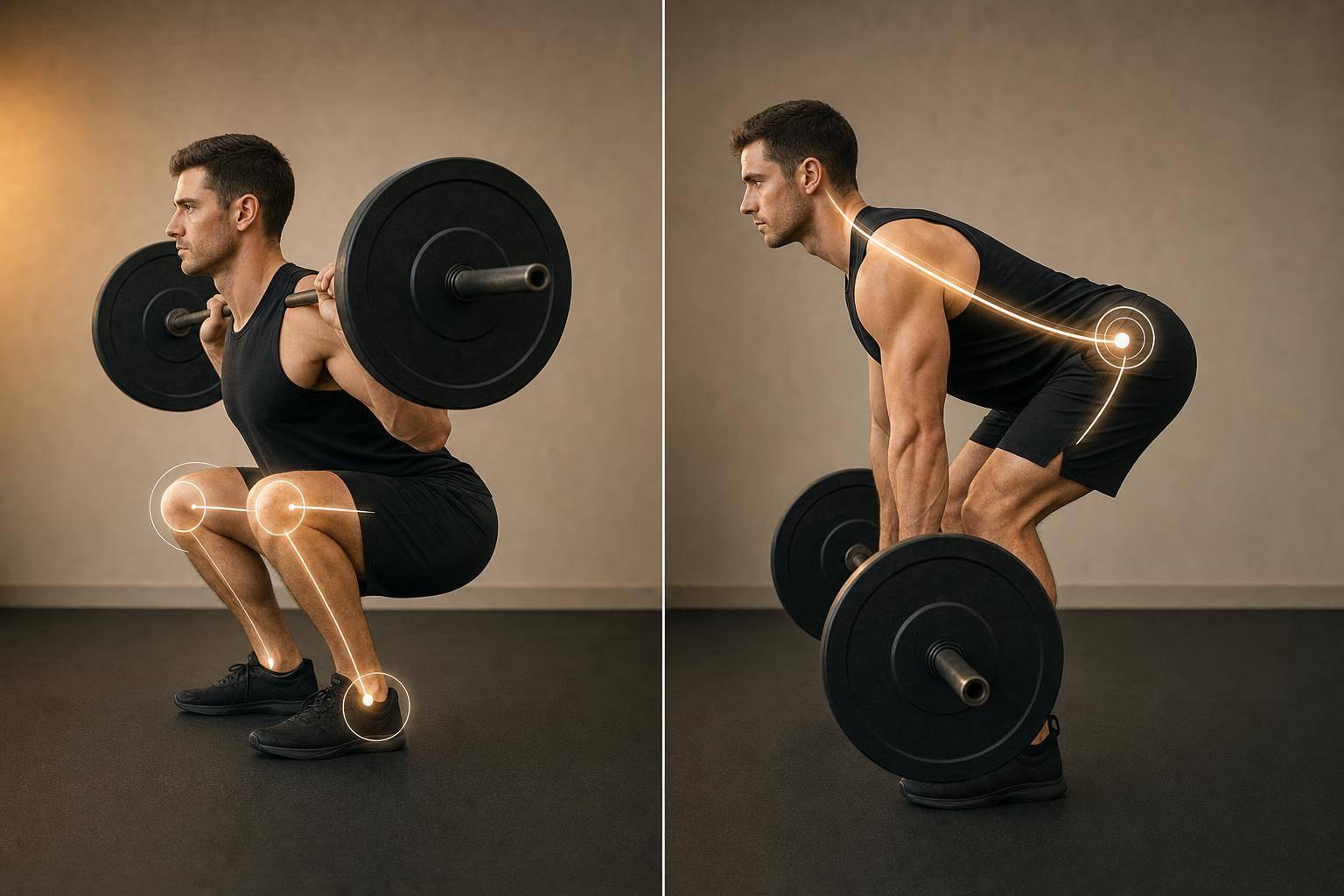
Squat vs Deadlift for Joint Stability
If your goal is joint stability, the squat and deadlift do different jobs. The squat hits knee and ankle control harder, while the deadlift puts more stress on hip and trunk control.
Here’s the short version:
- Choose the squat if you want to work on knee tracking, ankle control, and staying braced in a more upright position.
- Choose the deadlift if you want to work on hip control, bar path, and keeping your spine from rounding under load.
- Use both if you want more complete lower-body stability across the week.
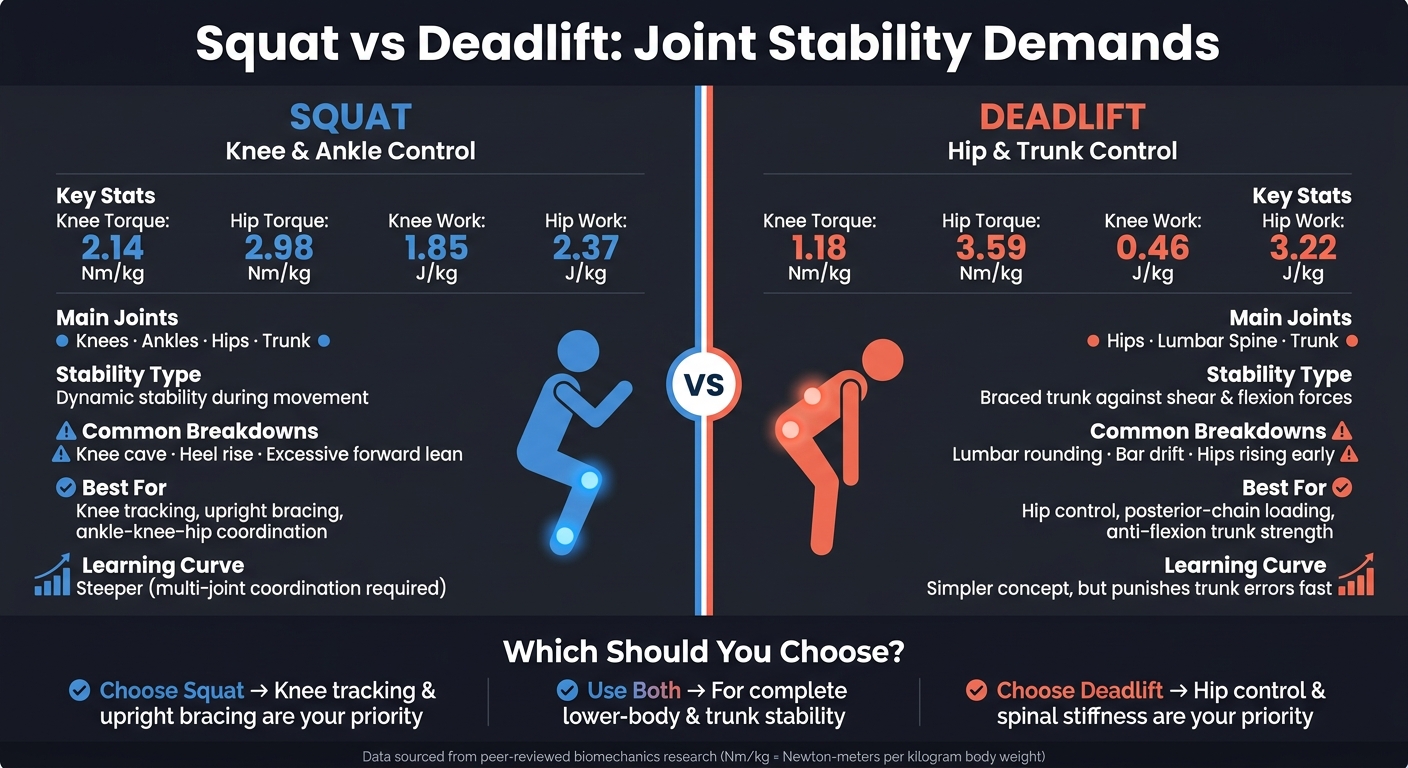
A few numbers make this clear. In the article, the squat shows more knee torque than the deadlift (2.14 Nm/kg vs. 1.18 Nm/kg). The deadlift shows more hip torque (3.59 Nm/kg vs. 2.98 Nm/kg). So if your knees cave in during squats, that matters. If your low back rounds in deadlifts, that matters too.
Squat vs Deadlift: Joint Torque & Stability Demands Compared
FMS Unplugged: Ep 9 - Squat vs. Deadlift: Which should you choose?
Quick Comparison
| Lift | Main joint focus | Common form slip | Best fit |
|---|---|---|---|
| Squat | Knees, ankles, hips, trunk | Knee cave, heel lift, forward lean | Knee control and upright bracing |
| Deadlift | Hips and trunk/spine | Low-back rounding, bar drift, hips shooting up | Hip control and anti-flexion trunk strength |
Bottom line: if you want to know which lift is better for stability, ask which joint needs more control. That answer usually points you to the right lift.
How the Squat and Deadlift Differ as Movement Patterns
The squat puts the bar on your back and asks your knees, hips, and ankles to work together. The deadlift puts the bar in your hands and shifts more of the job to a hip hinge. That one change alters the whole feel of the lift. It also changes which joints need to lock in and stay steady.
Squat: Upright Load with More Knee and Ankle Control
With the bar resting on your upper back, your torso stays more upright. To hit depth, your knees need to move forward and your ankles need to dorsiflex - often reaching 35–45° in a high-bar squat [2][4]. That forward knee travel puts the quadriceps under a heavy load as the main knee extensors. At the same time, the glutes and adductors help extend the hip and keep the femur tracking well. Your feet matter here too. They help you keep pressure through the midfoot and stop your heels from popping up or your arches from caving in.
The numbers make the pattern pretty clear. The squat creates more knee torque and knee work than the deadlift: 2.14 Nm/kg vs 1.18 Nm/kg, and 1.85 J/kg vs 0.46 J/kg [1][5]. In plain English, this is a lift built more around knee-driven control.
Deadlift: Hip Hinge with Higher Hip and Trunk Demands
The deadlift shifts the hard part to the hips and trunk. Since the bar hangs in front of your body, it pulls your torso forward. To keep the bar path straight and stop your spine from rounding, your glutes and hamstrings drive hip extension while your spinal erectors resist flexion isometrically. Your lats and upper back help keep the bar close, which cuts down the leverage working against your spine.
Hip torque in the deadlift reaches about 3.59 Nm/kg, compared with 2.98 Nm/kg in the squat [1][5]. Hip work is higher too - 3.22 J/kg versus 2.37 J/kg [1][5]. So while the squat leans harder on the knees and ankles, the deadlift puts more of the demand on the hips and trunk. That’s why cues like "keep the lats tight" and "pull the slack out" matter so much. They help keep the bar close and give your trunk a steadier base to work from.
Those mechanics make the split pretty simple: the squat leans toward knee and ankle stability, while the deadlift leans toward hip and spinal stability. The next step is to break that down further by looking at knee, hip, and spinal control on their own.
Joint Stability Demands: Squat vs Deadlift
The big split here is where control tends to give out first. In the squat, that usually means the knees and hips. In the deadlift, it’s more often the hips and spine.
Squat: Stronger Bias Toward Dynamic Knee and Hip Stability
The squat trains stability while you’re moving through the lift. That includes knee tracking, hip positioning, and trunk bracing under compression. As you descend, the knees move forward, the hips flex, and the ankles dorsiflex at the same time, while the trunk stays braced under a vertical load.
At the knees, the quads and hamstrings co-contract to steady the joint. At the hips, the glutes and external rotators help control femur position and keep the knees from collapsing inward.
With solid technique and enough ankle dorsiflexion, deeper squats can build knee stability by increasing co-contraction and spreading load across the joint. But if hip control or ankle mobility is limited, that same depth tends to expose the weak link instead.
Deadlift: Stronger Bias Toward Hip and Spinal Stability
The deadlift asks you to brace the trunk against a forward pull. The spine stays fairly fixed while the hips extend against a heavy load that wants to drag the torso forward. The glutes, hamstrings, and spinal erectors work together to keep the trunk rigid while the hips drive the bar upward.
If the brace gives way or the bar drifts away from the body, the lever arm on the lower back gets longer fast. That’s usually where the lift starts to fall apart.
Those differences show up pretty clearly once the weight gets heavy.
Comparison Table: Squat vs Deadlift by Joint Stability Goal
| Squat | Deadlift | |
|---|---|---|
| Main joints challenged | Knees, hips, ankles, trunk | Hips, lumbar spine/trunk; knees to a lesser degree |
| Stability demand | Stability during movement under compression | Braced trunk against shear and flexion forces |
| Common weak points | Knee cave, heel rise, forward lean | Lumbar rounding, bar drift, hips rising early |
| Knee demand | High, especially at depth | Low |
| Best for | Knee tracking, upright bracing, ankle-knee coordination | Hip control, posterior-chain loading, anti-flexion trunk strength |
Movement Control, Learning Curve, and Common Breakdowns
Why Squats Often Challenge Beginners at the Knees, Ankles, and Balance
These stability demands usually show up early as balance mistakes and position errors.
The squat tends to take longer to learn because it asks for ankle mobility, hip control, and steady balance over the midfoot all at once. That sounds simple on paper. Under a bar, it’s a different story.
Knee valgus often points to weak hip control or poor foot pressure. Heel rise usually means limited ankle dorsiflexion or a shift forward onto the toes. Excessive forward lean often shows up when the lifter runs out of ankle or hip mobility. These breakdowns matter because they increase joint stress and make the lift less stable as weight goes up.
A few fixes tend to help fast:
- Slow the descent
- Use a tripod foot: heel, big toe, and pinky toe pressing into the floor
- Work on ankle mobility before adding more load
Tools like CueForm AI can spot knee valgus, heel rise, and forward lean, then turn those issues into simple cues.
Why Deadlifts Expose Trunk Position Errors as Load Rises
The deadlift looks simpler at first. But once the bar gets heavy, small trunk errors can get expensive in a hurry.
It’s often easier to learn at the start because the pattern is more direct: hinge, keep the bar close, and stand up. That said, heavy deadlifts punish trunk mistakes fast.
Lumbar rounding, bar drift, and hips rising ahead of the shoulders all increase spinal loading and reduce stability. Simple cues like "drag the bar up your shins" and setting the lats before the pull can help keep the bar path tight. Squats also demand strong trunk stiffness; they just test it through a different load path.
The table below shows where each lift usually breaks down first.
Comparison Table: Control Demands and Breakdowns by Lift
| Squat | Deadlift | |
|---|---|---|
| Beginner learning curve | Steeper - requires depth, balance, and multi-joint coordination | Simpler concept, but trunk demands are immediate under load |
| Mobility demands | High ankle dorsiflexion and hip flexion | Moderate hip hinge tolerance |
| Main coordination challenge | Syncing knee and hip flexion while staying balanced over the midfoot | Maintaining a neutral spine and close bar path through the full pull |
| Most common form breakdowns | Knee valgus, heels lifting, excessive forward lean, posterior pelvic tilt at depth | Lumbar rounding, hips rising too fast, bar drift, overextension at lockout |
| Primary joint region affected | Knees and ankles; lumbar spine when forward lean or pelvic tuck shows up | Lumbar spine and hips |
Which Lift Fits Your Goal
Now that the main stability demands and the usual form problems are on the table, the next step is simple: match the lift to the joint pattern you want to train most.
Choose the Squat for Knee Control and Upright Bracing
Pick squats when knee tracking and ankle-knee-hip coordination are the main goal. At 70% of 1RM, back squats create about twice the knee moment of deadlifts, which means they train knee stability more directly with the foot planted [6].
Front squats keep you more upright while still hitting the quads hard. If you need a smoother ramp-up, controlled options like tempo goblet squats or box squats help you build knee tolerance step by step before adding more load [7][8].
Choose the Deadlift for Hip Control and Resisting Spinal Flexion
Pick deadlifts when hip control and spinal stiffness matter most. They create larger hip extensor moments and more work at the hip than squats [1][3]. Romanian deadlifts put more focus on hinge control, while trap-bar deadlifts shift more of the load toward the knees and less toward the trunk [3].
Use Both Lifts for Broad Lower-Body and Trunk Stability
Using both lifts during the week is often the cleanest way to train different kinds of stability without muddying the goal of each session. One day can center on knee-dominant control. Another can center on hip and trunk control.
| Day | Main Lift | Stability Focus |
|---|---|---|
| Squat day | Back squat or front squat | Knee tracking, upright bracing, ankle-knee-hip coordination |
| Deadlift day | Conventional or trap-bar deadlift | Hip hinge control, resisting spinal flexion |
| Optional technique day | Tempo squats or hinge variations | Movement quality at lower loads |
This setup gives the knees a bigger stability challenge on squat day, then lets the hips and spine take over on deadlift day. It’s a straightforward way to build more complete lower-body and trunk control across the week without dumping all the stress into one joint.
Key Takeaways and How to Check Your Technique
Squats lean more toward knee and hip control. Deadlifts lean more toward hip and trunk control. But the lift alone doesn’t do the job. Stability comes from clean reps.
Two form slips stand out fast:
- Knee cave
- Low-back rounding
Those are the clearest signs that a rep is missing the stability target.
Recording your lifts from the front and side is the easiest way to catch what you won’t notice in real time. CueForm AI can review squat and deadlift videos, flag knee collapse, spinal rounding, and bar-path drift, then give you clear cues for the next session. You can also use its AI coach chat to ask follow-up questions based on your goal.
FAQs
Can poor ankle mobility make squats less stable?
Yes. Limited ankle dorsiflexion can make squats less stable by forcing your body to compensate. The most common signs are heels lifting and too much forward torso lean.
Those changes can throw off squat mechanics and lower-body coordination. CueForm AI can help spot whether ankle limits are affecting your bar path or stability, and targeted mobility drills may help improve movement quality under load.
Which deadlift variation is best for trunk stability?
It depends on your goal and how you pull.
If you want less lower back strain while still keeping solid trunk control, the sumo deadlift is a strong option. The setup lets you keep a more upright torso, which can take some load off the lower back.
If your main focus is building control and avoiding spinal rounding, paused deadlifts are a better fit. Pausing the bar for 2 to 3 seconds kills momentum and forces you to hold a neutral spine.
Should beginners learn the squat or deadlift first?
For beginners, the main goal is movement quality. At this stage, picking a strict order between the squat and deadlift matters less.
Start by building sound patterns, body awareness, and control of a neutral spine and knee position before you add weight. One simple benchmark some coaches use is 3 sets of 20 full-range reps with perfect form.
CueForm AI can help analyze technique and give you cues based on how you move.