Real-Time Form Correction: Benefits for Lifters
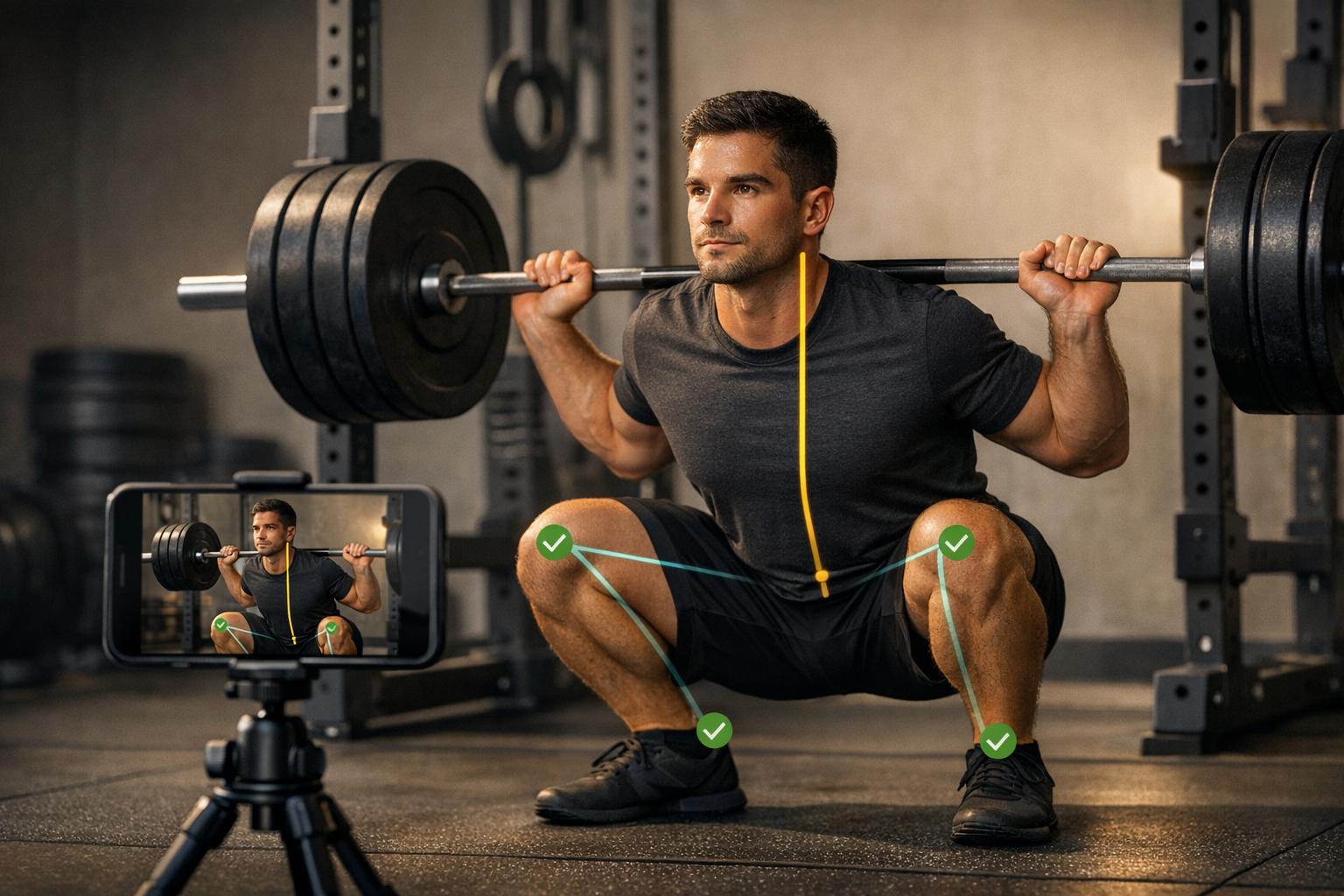
Real-time form correction is changing how lifters train. By using AI and computer vision, this technology provides instant feedback on your exercise technique, helping you lift safer and smarter. Here’s why it matters:
- Boosts Performance: Studies show a 9.76% increase in strength and 31.30% improvement in power with real-time feedback.
- Reduces Injuries: Form-related issues cause 60% of weightlifting injuries. AI systems cut injury rates by 20%.
- Improves Efficiency: Feedback during every rep helps correct mistakes as they happen, preventing bad habits.
Tools like CueForm AI analyze your movements, detect errors, and offer tailored cues - all through your smartphone. Whether you're a beginner or an experienced lifter, this tech ensures every rep counts by optimizing technique and minimizing risks.
Want safer, more effective workouts? Real-time feedback might be the key.
Real-Time Form Correction Benefits: Performance and Injury Reduction Statistics
Performance Benefits of Real-Time Feedback
Improved Strength Metrics
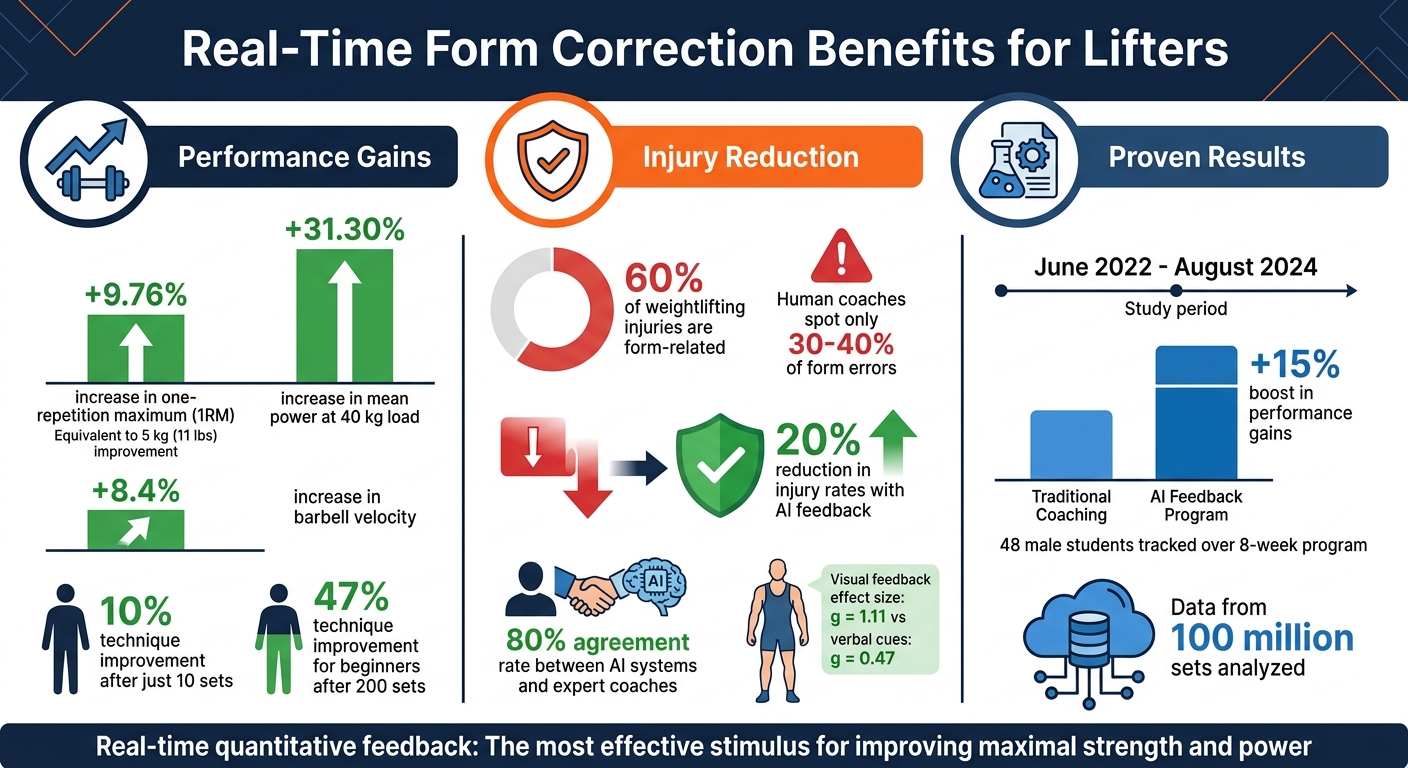
Real-time feedback has been shown to significantly enhance both maximal strength and explosive power. A study conducted between June 2022 and August 2024 by researchers at Prince Sultan University, led by Martin Pacholek, tracked the progress of 48 male students over an 8-week resistance training program. Participants using real-time quantitative feedback through the FITROdyne Premium device saw a 9.76% increase in their one-repetition maximum (equivalent to a 5 kg or approximately 11 lbs improvement) and a 31.30% increase in mean power at a 40 kg load (about 88 lbs). These results far exceeded the gains seen in groups that relied solely on verbal encouragement or received no extra feedback at all [5].
Interestingly, visual feedback proved to be more effective than verbal cues, with a larger effect size (g = 1.11 compared to g = 0.47). Research led by Jonathon Weakley at Australian Catholic University highlighted how tools offering visual overlays or on-screen displays enable lifters to make quicker, more precise adjustments during their sets [6].
"Real-time quantitative feedback proving to be the most effective stimulus for improving both maximal strength and power."
– Martin Pacholek, Department of General Studies, Prince Sultan University [5]
These strength gains are further supported by the efficiency boost real-time feedback brings to training sessions.
Better Training Efficiency
One of the standout advantages of real-time feedback is its ability to maintain consistent movement velocity. Studies show that feedback can increase barbell velocity by approximately 8.4%, ensuring a more effective training stimulus and enabling lifters to perform more productive reps at optimal intensity [8].
The timing of feedback is crucial. When lifters receive feedback after every single repetition - rather than waiting until the end of a set - they can correct common squat form mistakes as they occur, even as fatigue sets in [8]. Data collected from 100 million sets reveals that lifters can achieve a 10% improvement in technique after just 10 sets, with beginners showing gains of up to 47% after 200 sets [7].
Real-time feedback also helps to prevent the reinforcement of bad habits. By addressing form breakdowns like deviations in bar path or incorrect joint angles immediately, lifters can avoid inefficient movement patterns. Tools like CueForm AI analyze exercise videos to identify these form deviations and provide tailored corrections, ensuring every rep contributes to peak performance.
sbb-itb-c91a623
Reducing Injury Risk with Real-Time Correction
Preventing Injuries Before They Happen
Fatigue is a critical factor in strength training, often leading to dangerous form breakdowns. As lifters tire, their movements can become unsafe, increasing the risk of injury. AI-powered systems step in by identifying high-risk patterns in real time. For instance, knee valgus collapse - when the knees cave inward during a squat - is a common issue that significantly raises the likelihood of ACL injuries [1]. Immediate feedback, like the cue "spread the floor with your feet", helps activate the hip external rotators, correcting the form and preventing bad habits from taking root.
Other problematic patterns, such as spinal flexion, premature hip rise (commonly known as "stripper squats"), and uneven depth, are also flagged to avoid excessive strain on the lower back and hips [1][4]. For example, asymmetrical depth, where one hip dips lower than the other, can lead to SI joint dysfunction or hip impingement if left unchecked [1].
In team settings, human coaches often miss a significant number of form errors, spotting only about 30–40% of mistakes in real time [1]. Zach Lush, CFSC and Co-founder of SportSensAI, highlights this challenge:
"In a team setting, I can watch maybe 5-6 athletes closely during a lift session. The rest? I'm catching major breakdowns at best. The athletes who need the most eyes on them - beginners with poor movement patterns - are often the ones training alone... That's where injuries happen" [1].
By delivering immediate corrections, AI systems help reduce injury risks and support safer training practices.
Research on Injury Reduction
Research underscores the impact of AI-driven feedback in reducing injuries during resistance training. A study published in the Journal of Exercise Science tested the SportSensAI system with high school athletic teams and individual lifters. The results? A 20% drop in injury rates and a 15% boost in performance gains [1]. The system focused on critical issues like knee valgus and spinal flexion, alerting users when safety scores fell below 70 out of 100.
Additionally, a 2023 systematic review and meta-analysis found that providing consistent feedback during resistance training significantly improved technical skills. The most effective results occurred when feedback was given after every repetition [6].
Modern AI tools like CueForm AI are designed to make strength training safer. For example, FormCoach, developed by researchers at the University of Pennsylvania in October 2025, uses Vision-Language Models to detect subtle errors across 22 exercises. It provides real-time corrections, such as "Keep your back straight", to help lifters avoid lower back strain during deadlifts and squats [4]. Similarly, CueForm AI uses advanced video analysis to identify form breakdowns in exercises like squats, bench presses, and deadlifts. It delivers tailored cues to help lifters maintain proper form throughout their workouts.
As the FormCoach team puts it:
"Good form is the difference between strength and strain" [4].
AI-Powered Tools in Strength Training
How CueForm AI Works
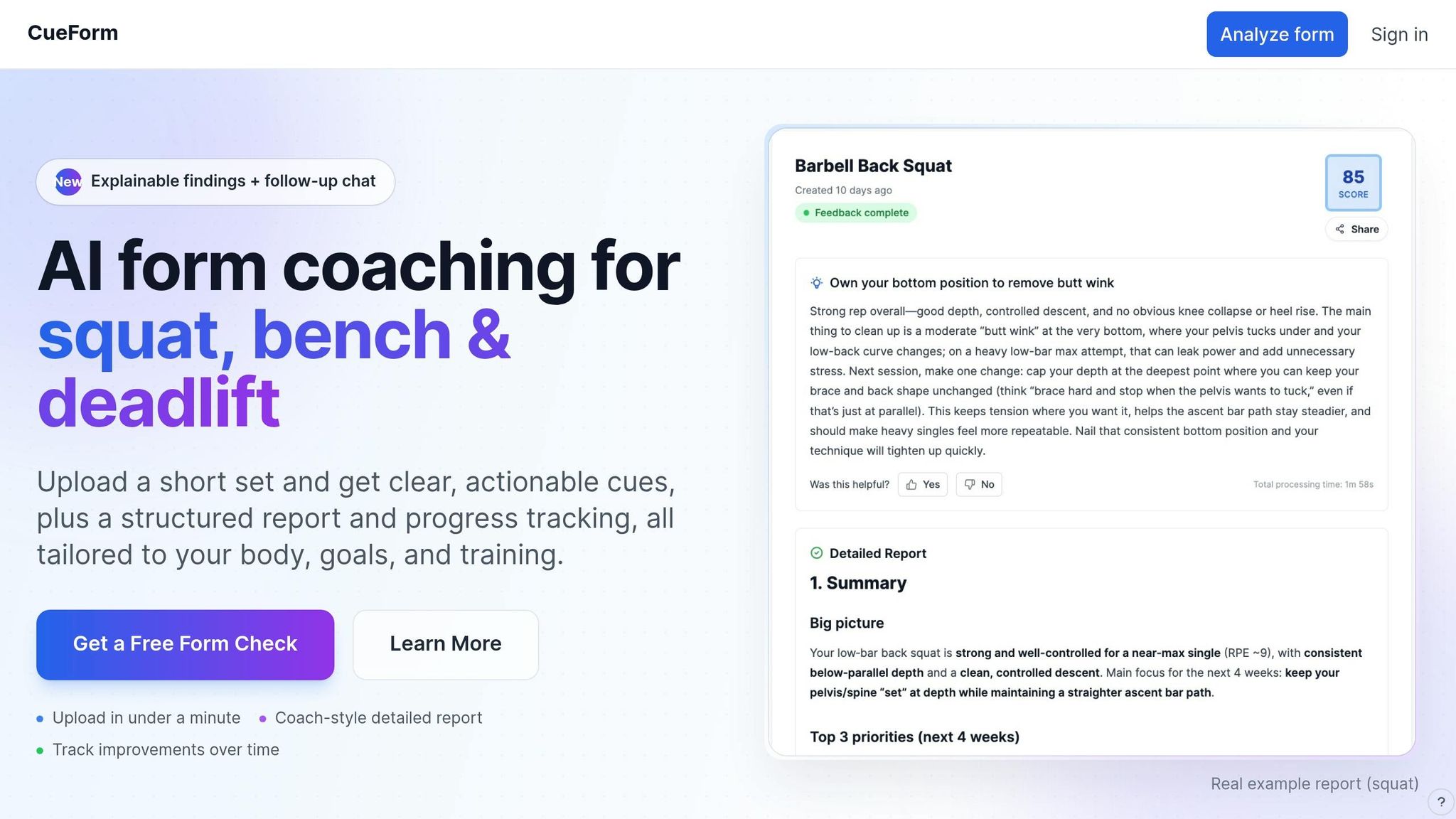
CueForm AI uses advanced computer vision and pose estimation technology to analyze strength training videos recorded on your smartphone. By tracking key joint angles - like those at the shoulders, hips, knees, and ankles - it creates a digital movement profile. This profile evaluates critical aspects of your lifts, such as bar path, posture, and movement patterns, to identify technical issues in exercises like the squat, bench press, and deadlift [3][9].
What sets CueForm AI apart is its ability to translate data into actionable advice. Instead of overwhelming you with raw metrics like "hip angle: 43 degrees", it offers practical cues, such as "drive your hips forward at lockout - you should feel your glutes squeeze" [3]. You can even customize the feedback by sharing your goals, physique details, and training plan, ensuring the advice aligns with your personal lifting style [3].
The tool also features an interactive AI coach chat, allowing you to ask questions and clear up any confusion. Each analysis includes a detailed breakdown of findings, offering transparency and explaining the metrics behind every piece of advice [3]. This approach ensures that the feedback is not only precise but also easy to understand, helping you make noticeable progress in your training.
Benefits of AI-Driven Form Coaching
AI tools like CueForm AI address a common challenge in strength training: the lack of personalized coaching. Many lifters either train alone or in group settings where individual feedback is hard to come by [1]. By providing expert-level guidance at scale, CueForm AI serves as both a personal coach for solo athletes and a valuable resource for trainers managing multiple clients.
The results speak for themselves. Studies show that AI systems achieve an 80% agreement rate with expert coaches when identifying form issues and assessing their severity [1]. These tools can spot subtle problems - like one hip dipping lower than the other during a squat or an early knee extension (often called the "stripper squat") - that are easy to miss but can increase the risk of injury [1]. Additionally, CueForm AI monitors factors like bar speed and tempo, helping you detect fatigue before it impacts your form. This allows you to adjust your training in real-time, reducing the likelihood of injuries [9].
CueForm AI also offers flexible pricing options. The Free Plan, priced at $0/month, provides unlimited quick feedback with basic insights and a limited AI coach chat feature. For those seeking more in-depth analysis, the Starter Plan is available for $10/month or $89/year, offering unlimited detailed reports and an extended AI chat quota for comprehensive feedback [3].
Why This AI Fitness Tracker Blows Others Away
Conclusion
Real-time form correction has been shown to reduce injuries by 20% and improve performance gains by 15% compared to traditional coaching methods[1]. These improvements can be the key to maintaining steady progress while avoiding setbacks that could disrupt a training routine.
Beyond boosting performance, this technology actively addresses injury prevention. Poor form is a leading issue that hinders effective training for beginners and experienced lifters alike[4]. By identifying dangerous patterns - like knee valgus or lumbar flexion - before they become ingrained, AI-driven tools provide the kind of proactive adjustments that solo lifters often miss.
CueForm AI offers expert-level feedback without requiring expensive gear or ongoing personal coaching. With plans starting at $10/month or $89/year, it provides affordable access to professional guidance[2]. For those just starting out, the Free Plan delivers unlimited quick feedback, ensuring anyone with a smartphone can benefit from expert insights.
When every rep matters, data-driven training helps you stay on track. Whether you’re looking to add serious weight to your lifts or simply want to train pain-free for years to come, real-time form correction provides the precision and accountability needed to train smarter. By combining accurate feedback with affordable pricing, this technology empowers lifters to work toward their goals with confidence and safety.
FAQs
Do I need special equipment to get real-time form feedback?
No fancy gadgets are required to get real-time feedback on your form. Tools like CueForm AI rely on computer vision and your smartphone's camera to evaluate your movements. This means you can refine your technique and lower the chance of injury without investing in any additional equipment. It's a straightforward and convenient solution for lifters.
How accurate is AI at spotting form mistakes in my lifts?
AI systems can now identify lifting form mistakes with over 95% accuracy by tracking key body landmarks. This technology offers precise, real-time feedback, often spotting errors that even seasoned coaches might overlook. The result? Better performance and a lower risk of injuries during strength training.
How should I record my squat, bench, or deadlift for the best results?
To get the best feedback on your squat, bench, or deadlift, record a short video with good lighting and a steady camera. Make sure your entire body is visible and try to capture multiple angles for a complete view of your form. Keep the video under a minute for easier analysis. A clear setup makes it easier to spot any imbalances or joint alignment issues, helping you fine-tune your technique and lower the risk of injuries.
Related Blog Posts
Plans
Choose the plan that best fits your needs.
Free
Try it out
Starter
Perfect for fitness enthusiasts