Progressive Overload for Squats, Bench, Deadlift Safety
Progressive overload is the key to building strength safely. It means gradually increasing the stress on your body through weight, reps, or intensity. For squats, bench presses, and deadlifts, this approach helps you gain strength while reducing the risk of injury. Here's what you need to know:
- Squats: Add weight slowly (5 lbs/session for beginners) and ensure proper depth and form. Use cues like "chest up" and "spread the floor" to maintain alignment. Tools like CueForm AI can analyze your squat videos and offer personalized feedback.
- Bench Press: Use small weight increments (2.5–5 lbs) and focus on bar path and tempo. Always use a spotter or safety pins for heavy lifts. CueForm AI can help identify issues like elbow flare or uneven lockouts.
- Deadlifts: Incorporate variations like deficit or paused deadlifts to target weak points. Watch for fatigue, maintain a neutral spine, and plan deload weeks every 4–8 weeks. CueForm AI can flag problems like hip misalignment or spinal rounding.
Key Takeaway: Prioritize proper form before increasing weight, monitor recovery, and use tools like CueForm AI to catch and correct subtle mistakes. Steady, safe progression is the goal.
Progressive Overload Safety Guidelines for Squats, Bench Press, and Deadlifts
How to Apply Progressive Overload Safely to Squats
Adding Weight Gradually and Progressing Depth
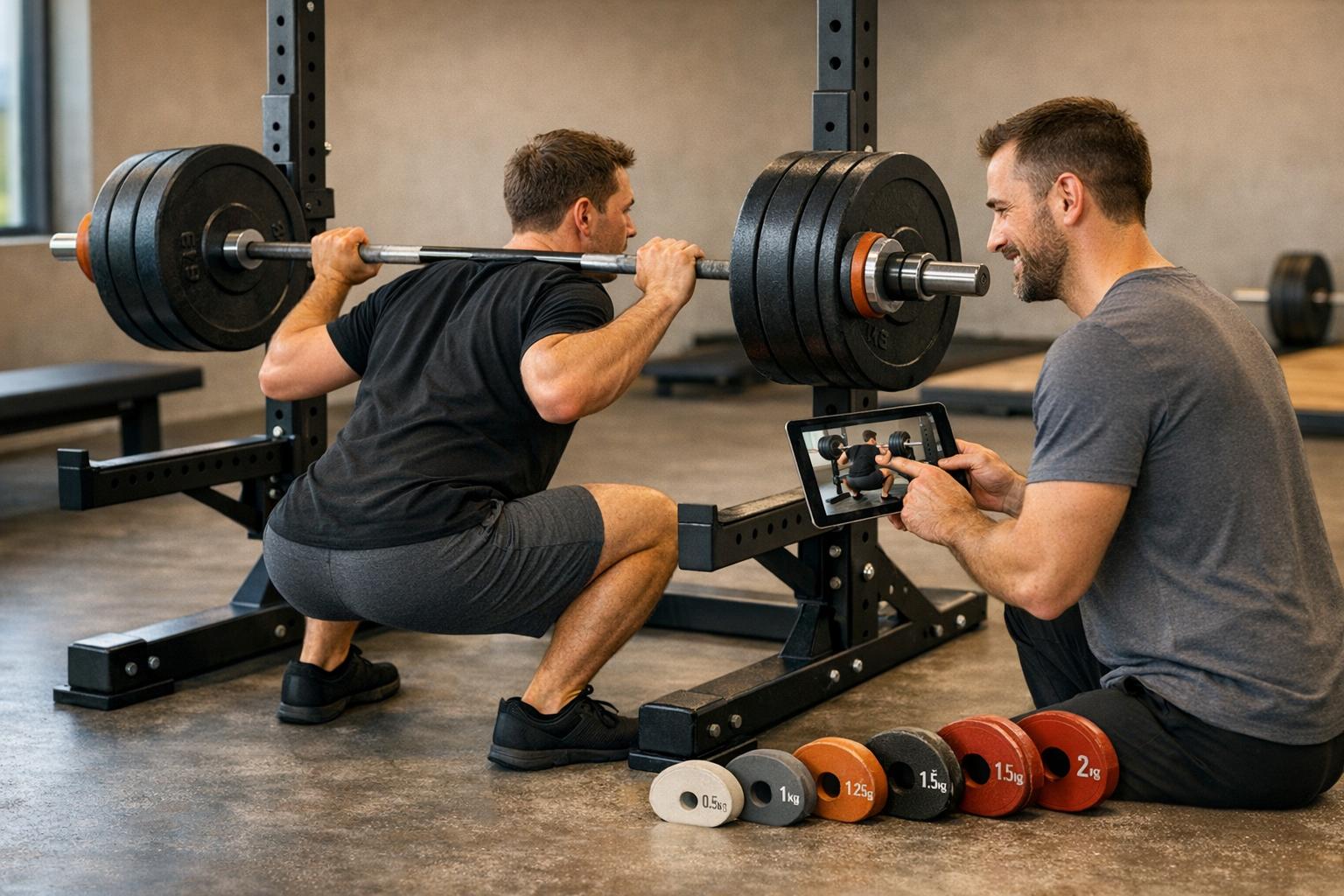
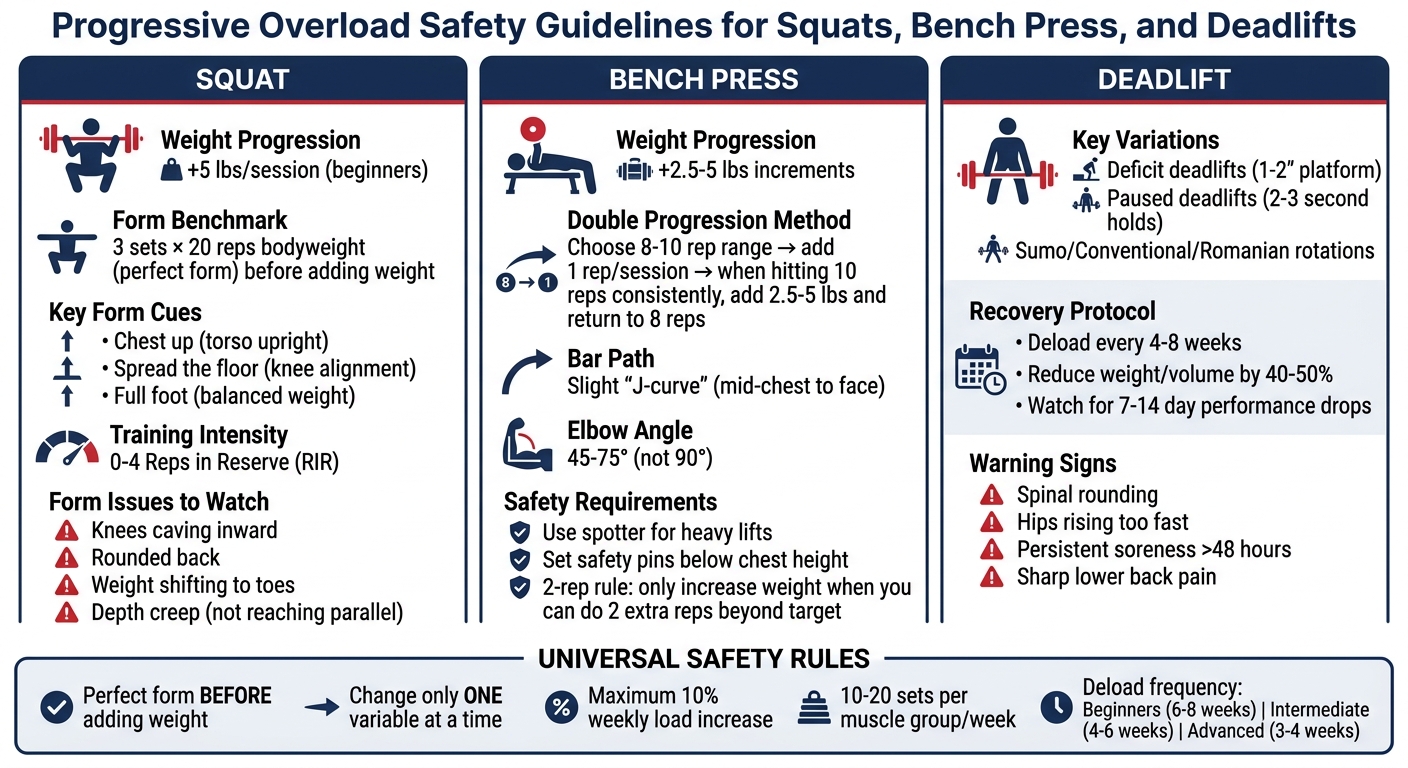
When increasing weight for squats, start small - around 5 lbs per session for beginners. Research from 2017 highlights that gradually increasing training loads is the most critical factor for building strength, even more than how often or how much you train [7].
Before adding weight, make sure your bodyweight squat form is solid. Strength coach Bret Contreras suggests a benchmark: perform 3 sets of 20 full-range reps with perfect form before moving on to external weights [2]. This ensures your body is ready to handle the added stress and reduces injury risk.
If hitting full depth is tough, try progressive distance training. Begin with box squats or partial-range movements, then gradually increase your range of motion - about an inch per week - until you can squat to full depth [2]. This method not only improves mobility but also ensures your strength gains are legitimate. Cutting your range of motion to lift heavier doesn't mean you're stronger; it just means your form is slipping [2].
To manage intensity effectively, aim to train within 0 to 4 Reps in Reserve (RIR). This range provides enough challenge to stimulate strength without excessive fatigue [9]. Use the "match or beat" rule: match last week's reps while adding a small amount of weight. If you can't, it's a sign to back off - drop your load by 10% after three consecutive missed sessions [7][9].
As the weight increases, maintaining proper form becomes even more important.
Prioritizing Form Over Weight
Good form isn't optional - it’s essential for both safety and progress. If your technique breaks down, you're not building strength; you're increasing your risk of injury.
Watch for common signs of poor form, like knees caving inward, a rounded back, shifting weight onto your toes, or the "good morning" squat (where your hips rise faster than your chest) [8][10][11]. Another issue is depth creep, where your range of motion decreases as the weight gets heavier. If you're not squatting to at least parallel, the load is likely too much [2][11].
Use specific cues to stay on track: "Chest up" to keep your torso upright, "Spread the floor" to encourage proper knee alignment, and "Full foot" to maintain balanced weight distribution. Incorporating the Valsalva maneuver - breathing in, bracing, and exhaling after the sticking point - can also enhance power and stability [8].
Anatomical differences, like variations in patellar tendon moment arms (ranging from 4 cm to 6 cm), mean some people need to work harder to achieve the same results. For instance, someone with a 4 cm moment arm must exert 50% more force to create the same knee extension as someone with a 6 cm arm [10]. This highlights the importance of focusing on your own progress rather than comparing yourself to others.
As Contreras puts it:
"If you do the same workout you did the week before, but with better form, that's progression" [2].
Improving your movement quality is just as valid as adding more weight.
Getting Squat Form Feedback with CueForm AI
Monitoring your squat form on your own can be tricky. Studies show that lifters often misjudge their effort levels (Reps in Reserve) by as much as 10 reps [9]. This is where objective feedback becomes crucial.
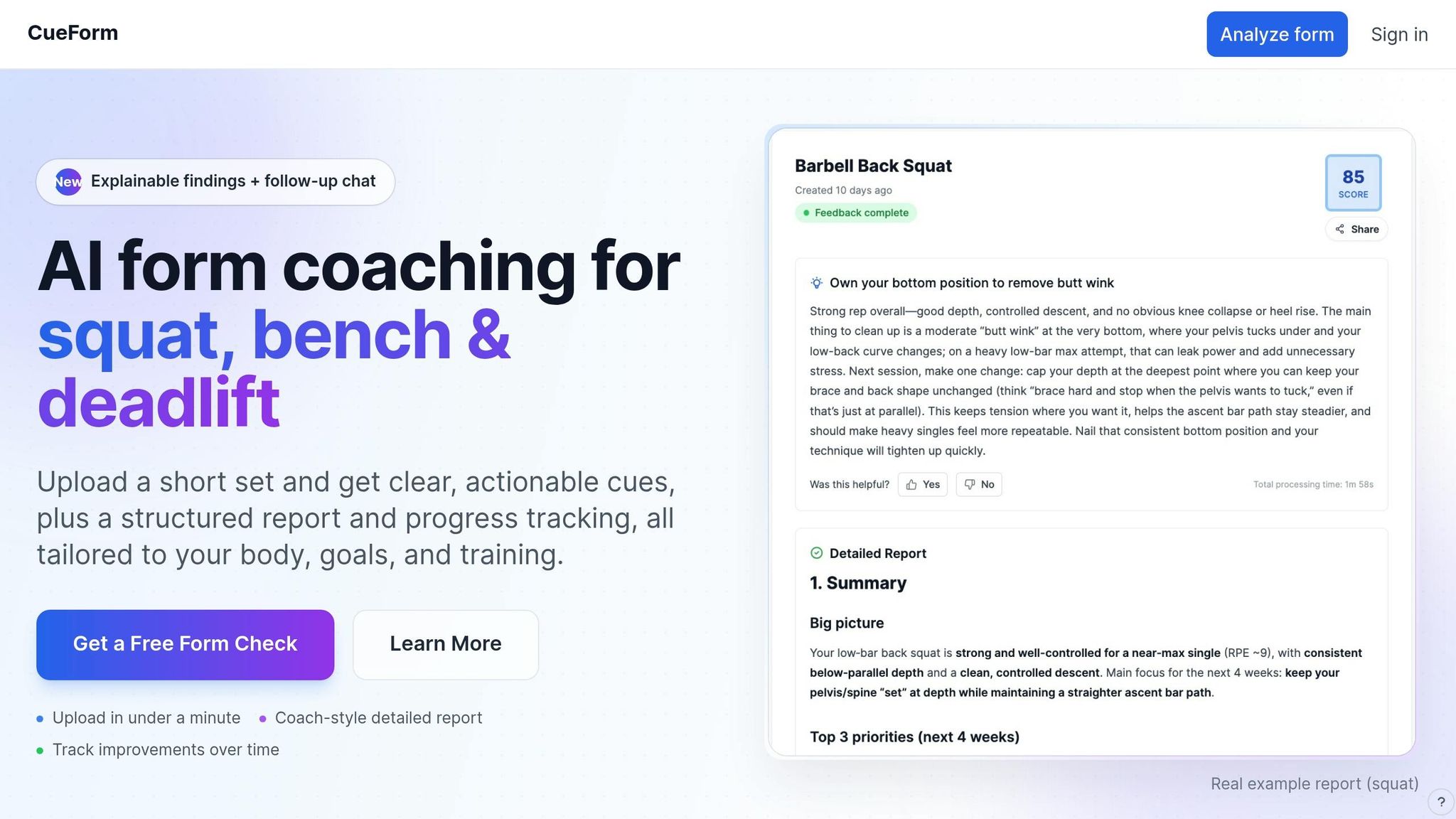
CueForm AI (https://cueform.ai) offers a solution by analyzing your squat videos to pinpoint specific issues like knee valgus, inconsistent depth, or torso collapse. Instead of generic advice, the platform provides personalized cues tailored to your movement. For instance, if your knees cave during the ascent, CueForm AI will suggest targeted fixes to address the problem before it becomes a habit.
The platform also allows you to ask follow-up questions about your technique, helping you understand not just what to fix, but why it matters. This is especially helpful when managing progressive overload, as it ensures your form stays consistent as the weight increases. CueForm AI offers free quick feedback or a detailed report plan for $10/month or $89/year.
How to Apply Progressive Overload Safely to Bench Press
Increasing Weight, Tempo, and Volume
The double progression method is a smart way to gradually increase the weight you lift on the bench press. Here’s how it works: choose a rep range, like 8–10 reps, and aim to add one rep per session until you reach the top of that range for all your sets. Once you hit 10 reps consistently, increase the weight by 2.5–5 lbs and start back at 8 reps [13][14]. This method makes progress steady and helps you avoid overloading too quickly.
For upper-body lifts, small weight increases are crucial. Even a 10 lb jump can be too much for many lifters, as it often represents a 6% increase - more than most can handle consistently [13]. Stick to 2.5–5 lb increments to keep making progress. If your gym doesn’t have fractional plates, investing in a pair of 1.25 lb plates can make a big difference.
You can also adjust tempo to make your bench press harder without adding more weight. For example, slowing the eccentric phase (lowering the bar) to 2–3 seconds increases time under tension [13]. This is especially helpful when you’re between weight jumps or working on perfecting your form. Speaking of form, the bar path should follow a slight "J-curve", where the bar touches your mid-chest (around the nipple line) and moves back toward your face as you press it up [14].
Increasing volume is another way to build strength and muscle. Once you’ve maxed out your reps, add an extra set to your workout [13]. However, don’t cheat yourself by bouncing the bar off your chest or lifting your hips off the bench - those reps don’t count as progress.
"Adding a rep by using excessive momentum, shortening range of motion, or bouncing the weight does not count as progressive overload. It is regression disguised as progress" [13].
To ensure safe progression, apply the 2-rep rule: only increase weight when you can perform two extra reps beyond your target with perfect form [12]. This gives you a cushion to handle the heavier load without risking failure.
With these methods in place, it's essential to also focus on safety to prevent injuries.
Using Spotters and Safety Equipment
As you lift heavier weights, the risk of injury - particularly to your shoulders - goes up. This makes using spotters and safety equipment non-negotiable. The bench press is one of the most common exercises linked to shoulder injuries, often due to poor setup or attempting weights beyond your capacity [14]. A spotter or safety pins in a power rack are must-haves when lifting heavy or pushing close to failure.
A spotter can assist with the lift-off, help keep your shoulders retracted, and watch your bar path [15][16]. Before starting, communicate clearly with your spotter - agree on a countdown (like "one-two-three"), the number of reps, and any specific details like pauses or tempo [15][14]. If the bar starts to drop during the lift, a spotter can step in immediately to prevent injury [15][16].
If you’re training alone, set safety pins in a power rack just below your chest height when you’re arched. This setup lets you safely bail on a failed rep by relaxing your arch and letting the bar rest on the pins [15][14].
"The preferred solution is to use safeties or a spotter whenever possible" [15].
Some lifters skip collars so they can tilt the bar and dump plates in an emergency, but this should only be a last resort. Safety pins are far more reliable [15].
"The risk of being pinned under a barbell is not worth one extra rep" [14].
As you increase the weight, make sure you’re following these safety measures:
| Safety Feature | Primary Function | Best Use Case |
|---|---|---|
| Spotter | Assists with lift-off, monitors bar speed, and helps re-rack missed reps | Heavy sets, 1RM attempts, or when using a dedicated bench station |
| Safety Pins/Arms | Provides a physical catch for the bar to prevent it from crushing the lifter | Training alone or in a power rack; essential for bailing safely |
| J-Hooks | Holds the bar at the correct height for a safe unrack | Ensuring the bar starts at a height that doesn’t require shrugging to unrack |
These precautions are key to safely progressing in your bench press training.
Getting Bench Press Form Feedback with CueForm AI
Bench press technique can break down in sneaky ways - your elbows might flare too much, your bar path might drift, or one arm might lock out faster than the other. These small issues often go unnoticed until they cause pain or stall your progress.
CueForm AI (https://cueform.ai) offers a way to analyze your bench press videos for specific form issues like improper elbow angles, inconsistent bar paths, or failure to keep your shoulder blades retracted. Instead of generic advice, it provides personalized cues tailored to your movement. For example, if your elbows are flaring to 90 degrees (a common cause of shoulder problems), CueForm AI might suggest tucking them to 45–75 degrees to protect your shoulders [14].
The platform also allows you to ask follow-up questions about your form, helping you understand why certain changes are necessary. This is especially helpful as you start lifting heavier weights, ensuring your technique stays solid as the load increases. CueForm AI offers free quick feedback or a more detailed analysis plan for $10/month or $89/year, making it a practical tool whether you’re a casual lifter or chasing serious strength goals.
The Ultimate Guide To Progressive Overload
How to Apply Progressive Overload Safely to Deadlifts
When it comes to deadlifts, safely applying progressive overload requires a thoughtful approach to technique, variations, and recovery.
Using Variations and Pauses to Build Strength
Deadlift variations can help you build strength without always resorting to heavier weights. For example, deficit deadlifts, performed by standing on a 1–2 inch platform, force you to pull through a longer range of motion. This increases tension and the time your muscles are under strain, which can enhance growth without immediately adding weight [3]. Training through a fuller range of motion has been shown to stimulate 2–3 times more muscle growth compared to partial ranges [18].
Another useful tool is the paused deadlift, where you hold the bar for 2–3 seconds at specific points during the lift. This eliminates momentum, helping you build control and maintain a neutral spine [3]. If you're struggling with the initial pull off the floor, pause just above it. If the lockout is your weak point, pause at mid-shin or knee level to strengthen that phase of the lift.
Rotating through different deadlift variations can also help prevent plateaus and target specific muscle groups. For example:
- Sumo deadlifts reduce strain on the lower back by allowing a more upright torso position.
- Conventional deadlifts place a greater emphasis on the lower back.
- Romanian deadlifts focus on the hamstrings and glutes while minimizing spinal loading [17].
By incorporating these variations, you can address weak points and progress safely.
Monitoring Fatigue and Recovery Needs
Deadlifts are demanding on your body, and overtraining can stall your progress. If your performance dips or your reps drop consistently over 7–14 days, it’s a sign you may be overreaching [19]. Other warning signs include persistent soreness lasting more than 48 hours, disrupted sleep, or feeling drained during warm-ups.
Form breakdown is another red flag. If your back starts to round during heavy pulls or you’re grinding through reps with poor posture, you’re putting yourself at risk of injury. As Outlift puts it:
"If your spinal erectors are giving out, you've already failed. Try not to do that" [18].
Sharp pain, especially in the lower back, is a signal to stop immediately and reassess either your technique or the weight you’re using [17].
To manage fatigue effectively, plan a deload week every 4–8 weeks (or every 3–4 weeks for advanced lifters). During this period, reduce your training weight and volume by 40–50% to allow proper recovery [3][19]. If you notice performance drops, lingering soreness, or disrupted sleep for 7–14 consecutive days, it’s time to deload. Using tools like Reps in Reserve (RIR) - starting a training block at 3–4 RIR and working toward 0 RIR before deloading - can help you stay in the optimal range for growth [9].
Staying on top of your recovery and form is crucial for long-term success.
Getting Deadlift Form Feedback with CueForm AI
Perfecting your deadlift form can be tricky without a coach. Subtle issues - like your hips rising too quickly, your back rounding slightly, or your shoulders drifting forward - can increase your injury risk, especially as the weight gets heavier.
This is where CueForm AI comes in. By analyzing your deadlift videos, CueForm AI identifies problems like hip misalignment, spinal rounding, or shoulder drift. It then offers personalized cues tailored to your movement patterns. For example, if your hips rise faster than your shoulders, shifting the load onto your lower back, CueForm AI might suggest engaging your lats more or adjusting your starting position to maintain a consistent torso angle throughout the lift.
The platform also features an AI coach chat, so you can ask follow-up questions about your technique. CueForm AI offers unlimited quick feedback for free, with an option for detailed analysis through the Starter plan at $10/month or $89/year. Whether you’re lifting recreationally or chasing ambitious goals, this tool can help you fine-tune your form and stay injury-free.
Preventing Common Injuries and Overtraining
Progressive overload is a powerful tool for building strength, but it can backfire if your form slips or you don’t allow enough time for recovery. These missteps can lead to injuries or burnout.
Perfecting Form Before Adding Weight
Before you start piling on the weight, focus on nailing your technique. Injuries during the bench press, for example, often come from issues like an improper rack height or bouncing the bar. With squats and deadlifts, problems like poor alignment or reduced range of motion can creep in as the weight increases [3][6][20]. Maintaining consistent squat depth is especially important as you progress [2]. Strength coach Bret Contreras puts it best:
"Progressive overload should never be prioritized over proper form... your muscles will not be forced to do more if your form gets sloppy" [2].
When adjusting your training, change only one variable at a time. If you’re adding weight, avoid increasing reps or cutting rest periods simultaneously. This keeps the overall stress on your body manageable [1][4]. Make small, gradual increases in load to protect your technique [13][20]. Fractional plates can be particularly helpful for upper body lifts, allowing for steady progress without sacrificing form [4][22].
In addition to proper technique, giving your body enough time to recover is essential for avoiding overtraining.
Allowing Adequate Recovery Between Sessions
Muscle growth doesn’t happen during your workout - it happens while you recover [3]. Overtraining can occur if your body’s nervous system and connective tissues don’t get enough time to adapt. Warning signs include persistent fatigue, frequent illness, trouble sleeping, or mood swings [21]. If your progress stalls for three weeks straight, or if warm-up sets suddenly feel heavier than usual, it might be time to scale back [3].
A slower bar speed during warm-ups is another red flag that you may need to reduce your session intensity [5]. Similarly, if a weight that typically feels like an RPE 8 (leaving 2 reps in reserve) starts to feel like an RPE 9 (leaving only 1 rep in reserve), it’s a cue to prioritize recovery [5].
To manage fatigue, consider incorporating a deload week every 4–8 weeks. During this week, reduce both the weight and volume of your training by 40–50% [3]. Beginners might need a deload every 6–8 weeks, while intermediate lifters may benefit from one every 4–6 weeks. Advanced lifters might need them more frequently, around every 3–4 weeks [3]. These lighter weeks allow you to maintain your movements at a lower intensity, preserving your technique while giving your body a chance to recover. As LoadMuscle puts it:
"Planned deloads are not weakness. They are strategy" [3].
Most lifters find success with 10–20 sets per muscle group each week. Going beyond this can lead to diminishing returns and greater fatigue [3][21]. To stay on the safe side, aim to increase your total training load by no more than 10% per week [21].
By keeping a close eye on your recovery and sticking to proper form, you can steadily and safely increase your strength.
Using CueForm AI to Reduce Injury Risk
Even with solid technique and recovery habits, regular form checks are critical for avoiding injuries. Small breakdowns in form can be hard to spot on your own. For example, your hips might rise too quickly during a deadlift, your squat depth could decrease as the weight goes up, or you might unknowingly bounce the bar during a bench press. Over time, these seemingly minor issues can lead to bigger problems as the weights get heavier.
CueForm AI (https://cueform.ai) is a tool designed to help you catch these subtle mistakes. By analyzing videos of your squat, bench press, and deadlift, it identifies technical flaws that might otherwise go unnoticed. The platform provides personalized, actionable cues tailored to your specific movement patterns. For instance, if your squat depth starts to shrink, CueForm AI will flag the issue and offer adjustments to help you maintain a full range of motion. Similarly, if your bench press bar path shifts forward - putting extra strain on your shoulders - it will suggest corrective steps.
With its AI coach chat feature, you can even ask follow-up questions about your form, making it easier to fine-tune your technique between sessions. By addressing form issues early, you can prevent them from turning into injuries, allowing you to lift safely over the long haul. CueForm AI offers unlimited quick feedback for free, with a Starter plan available for $10/month or $89/year for more detailed analysis.
Conclusion
Progressive overload is at the heart of strength training, but it only delivers results when applied with care. Increasing weight is important, but it must go hand-in-hand with proper form to avoid injuries. For exercises like squats, bench presses, and deadlifts, this means sticking to consistent depth, bar path, and tempo as you add weight. Using smaller weight increments can help you make steady, sustainable progress.
Recovery is just as important as the time spent lifting. Muscles grow and adapt during rest, so prioritizing recovery is critical. Incorporate regular deload weeks and pay attention to signs of fatigue to prevent overtraining and setbacks.
"Your muscles don't care which method you use - they only respond to progressive mechanical tension over time" [4].
This highlights that progression doesn’t always mean adding weight. You can also challenge your muscles by increasing reps, slowing your tempo, or even shortening rest periods when heavier weights aren’t an option.
It’s easy to miss small form issues until they turn into bigger problems. A slight hip shift during a squat or a forward bar path on the bench press might seem minor but could eventually lead to pain or injury as the weight increases. Tools like CueForm AI (https://cueform.ai) can help you catch these subtle mistakes early. By analyzing your lift videos, it provides instant feedback for free, with detailed reports available for just $10/month. This makes it an affordable way to stay on top of your technique as you progress.
FAQs
How do I know when to add weight vs. add reps or slow tempo?
When choosing between adding weight, increasing reps, or slowing down your tempo, it all boils down to your specific goals and current progress. If your aim is to build maximal strength and you can complete all your target reps with proper form, it’s time to add more weight.
On the other hand, if adding weight isn’t an option, tweaking the number of reps or adjusting the tempo can be just as effective. These changes not only increase training volume but also help refine your technique and keep your workouts challenging. Plus, they’re a great way to avoid hitting a plateau.
What are the clearest signs I should deload or back off training?
If your workouts start to feel unusually tough, or you notice joint pain, trouble sleeping, low motivation, or lingering fatigue without any specific injury, it might be time to take a step back. These are often signs of accumulated fatigue or overtraining, signaling that your body needs some recovery time.
How should I film my squat, bench, or deadlift for CueForm AI feedback?
To receive feedback from CueForm AI, upload a short video of your squat, bench, or deadlift. Ensure the video captures your entire body and the bar path clearly, preferably from a side or front angle. This allows for precise analysis. CueForm AI will then deliver tailored cues to help refine your technique, lower the chance of injury, and monitor your progress over time.