Joint Adaptation in Progressive Overload: What Science Says
Your joints are vital in strength training, especially under heavy loads. They handle immense forces during exercises like squats and deadlifts, with elite lifters’ knees managing over 4,600 pounds of force at near-maximal effort. This article breaks down how progressive overload impacts your joints, connective tissues, and nervous system, ensuring long-term strength and joint health.
Key Takeaways:
- Joints adapt to stress: Tendons become stiffer, cartilage adjusts to distribute forces better, and the nervous system improves stability.
- Progressive overload methods: Increasing weight (load progression) or reps (repetition progression) builds strength and muscle while keeping joints safe.
- Protect your joints: Gradual increases (≤10% weekly), proper form, and recovery are critical for avoiding injury.
- Research insights: Tendon stiffness peaks within 8 weeks, and repetition progression boosts muscle repair more than load progression in some cases.
- Tools for safety: AI-based movement analysis helps monitor joint alignment and improve training technique.
By understanding how your joints respond to mechanical stress, you can train smarter and reduce injury risks while achieving strength goals.
The REAL Reason We Train: Progressive Overload Explained | Judd Lienhard
How Joints Adapt Structurally to Progressive Overload
When you consistently lift heavy weights, your joints undergo notable structural changes, particularly in connective tissues like tendons, ligaments, and cartilage. These changes aren't just interesting - they're essential for building long-term strength safely and effectively.
Connective Tissue Remodeling
One of the most fascinating aspects of joint adaptation is how tendons respond to mechanical loading. Research shows that tendon stiffness increases significantly (SMD 0.74), mainly due to improvements in the material's quality rather than its size. Specifically, the tendon's Young's modulus - a measure of stiffness - shows a major increase (SMD 0.82), while the cross-sectional area only grows slightly (SMD 0.22) [2]. Think of it like upgrading from a regular rope to a steel cable: the material becomes much stronger without needing to get much thicker.
"A stiffer tendon experiences less strain at a given load and stores more energy at a given strain, and a stronger tendon resists a greater external load prior to failure." - Springer Nature [2]
Loading tendons at 70%–90% of your maximum voluntary contraction (MVC) triggers growth factors that increase collagen production and improve collagen alignment. The sweet spot for tendon strain is between 4.5% and 6.5% [2][3].
A 2024 study from Humboldt-Universität zu Berlin involving 39 men found that tendon stiffness improvements peak within eight weeks of training at 90% MVC. These gains are mostly due to better material properties rather than size increases [3]. In short, tendons adapt quickly when exposed to the right kind of stress.
As tendons become stronger and stiffer, they change how forces are distributed across your joints, ultimately enhancing stability.
Load Distribution and Joint Stress
These connective tissue changes significantly affect how forces are spread across joint surfaces. For example, when axial loading of 400 N (about 90 lb) is applied, the tibiofemoral cartilage contact area increases by 11.6% [4]. But this expansion isn't even across the joint. In the medial compartment of the knee, cartilage contact area grows by 15.0%, compared to just 6.7% in the lateral compartment [4].
The meniscus also plays a critical role in this process. Under load, it undergoes a slight shift - referred to as "controlled radial displacement" - to allow more cartilage-to-cartilage contact. Interestingly, in the medial compartment, the femoral-meniscal contact area decreases by 9.5% as this shift occurs [4]. This isn't a flaw; it's the joint's way of redistributing forces across a broader area for better efficiency.
When you combine stiffer tendons with improved load distribution, your joints gain a protective advantage. Studies comparing single massive overload events to gradual, progressive loading reveal that repetitive, controlled stress preserves the subchondral plate and minimizes cartilage damage. In contrast, sudden, intense shocks can cause more severe harm [5].
Neuromuscular Changes That Support Joint Stability
While tendons and cartilage gradually adapt to training, your nervous system steps in quickly to protect your joints during progressive overload. These neural adjustments are crucial for maintaining joint stability as you handle heavier weights.
Improved Motor Unit Recruitment
When lifting at 85%–95% of your one-rep max (1RM), your central nervous system (CNS) activates additional motor units. This adaptation enhances how efficiently your muscles work rather than increasing their size. In fact, most strength gains during the first 2 to 6 weeks of a new training program come from improved neuromuscular coordination rather than muscle growth [17].
"Neural adaptations refer to changes in the central nervous system (CNS) and neuromuscular system that enhance the body's ability to produce force... leading to greater neuromuscular efficiency." - Speediance [17]
Another key change is the reduced interference from antagonist muscles - those that oppose the primary movers. For instance, during a squat, your hamstrings naturally counteract your quadriceps to some extent. Over time, your CNS minimizes this opposing activity, promoting smoother and more efficient movement. This adjustment also improves joint control [11]. Research highlights that your nervous system fine-tunes the activation balance between specific muscles, such as the vastus lateralis and vastus medialis, to reduce joint stress. This optimization can occur within just 3 to 5 days of consistent training [9]. These neural changes also enhance proprioceptive control, adding another layer of joint stability.
Proprioception and Joint Control
Building on motor unit recruitment, improved proprioception further sharpens joint stability. Proprioception is your body's ability to sense limb position and force, often referred to as a "sixth sense." Specialized sensors in your muscles, tendons, joints, and skin send constant feedback to your brain about movement, position, tension, and force [14].
"Proprioception is the sense that tells your brain where all your body parts are, even if you've got your eyes closed, even when you're upside down in a handstand." - Molly Shaw Wilson, MS OTR/L BCP [12]
As you progress in a strength program, this feedback system becomes more refined, allowing for quicker reactions and more precise force production [12]. For example, improved proprioception helps keep your knees aligned during a squat, preventing them from collapsing inward - without requiring conscious effort [15]. Studies also show that proprioceptive training enhances knee joint position sense, contributing to long-term athletic improvement [13]. Together, these advancements in motor unit recruitment and proprioception work hand in hand to stabilize your joints under increasing loads.
Repetition Progression vs. Load Progression: What Studies Show
Repetition vs Load Progression: Muscle Growth and Strength Gains Comparison
Key Findings from Recent Studies
Researchers have been digging into how different training strategies - repetition progression versus load progression - affect muscle and joint adaptations. Two major studies shed light on this.
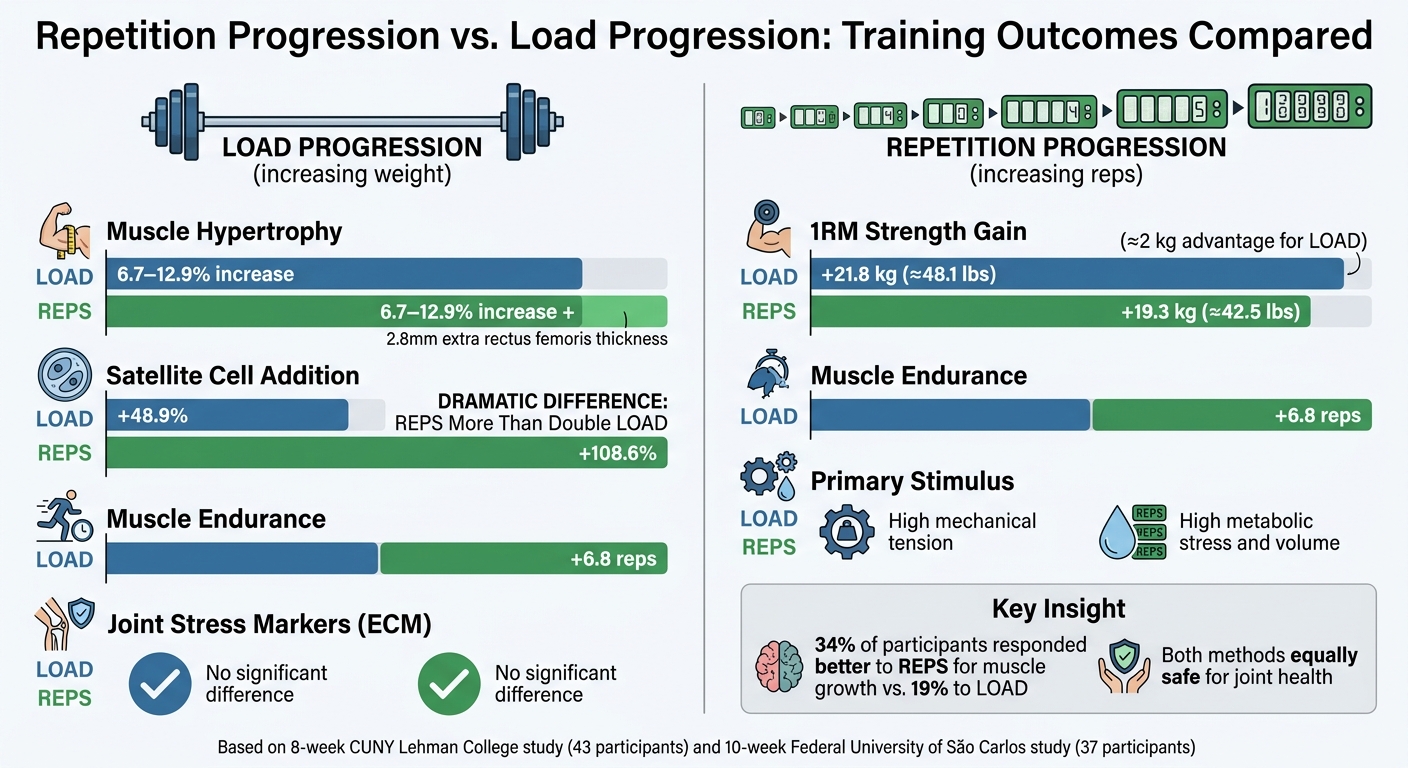
The first, conducted in 2022 at CUNY Lehman College, involved 43 resistance-trained participants in an 8-week lower-body program. One group focused on increasing weight while maintaining repetitions between 8–12 (LOAD), while the other increased repetitions while keeping the weight constant (REPS). The findings? The LOAD group improved their squat 1RM by about 2.0 kg (≈4.4 lbs) more than the REPS group. However, the REPS group saw a 2.8 mm greater increase in rectus femoris thickness, showing more muscle growth in that area [1][18].
"Both progressions of repetitions and load appear to be viable strategies for enhancing muscular adaptations over an 8‑week training cycle, which provides trainers and trainees with another promising approach to programming resistance training."
- Daniel Plotkin, Researcher, CUNY Lehman College [1]
Fast forward to 2025, a study from the Federal University of São Carlos added new perspectives. Over 10 weeks, 37 participants were monitored, and researchers discovered that 34% responded better to repetition progression for muscle growth, compared to 19% who saw more benefits from load progression [10]. The REPS group also showed a massive 108.6% increase in satellite cell content - key players in muscle repair and growth - while the LOAD group achieved a 48.9% increase [10].
When it comes to joint health, both methods were equally safe. Biomarkers for extracellular matrix (ECM) remodeling, which indicate how tendons, ligaments, and cartilage adapt, showed no significant differences between the two approaches. This suggests that gradual progressive overload is safe for joint integrity, regardless of the method used [10]. These findings highlight how repetition and load progression tap into different pathways for muscle growth and strength, offering flexibility in training strategies.
Comparison Table: Repetition Progression vs. Load Progression
| Metric | Load Progression (LOAD) | Repetition Progression (REPS) |
|---|---|---|
| Muscle Hypertrophy | 6.7–12.9% increase [19] | 6.7–12.9% increase; slightly higher for rectus femoris (+2.8 mm) [18][19] |
| 1RM Strength Gain | +21.8 ± 21.2 kg (≈48.1 lbs) [18] | +19.3 ± 7.7 kg (≈42.5 lbs) [18] |
| Satellite Cell Addition | +48.9 ± 63.1% [10] | +108.6 ± 77.0% [10] |
| Muscle Endurance | +6.6 ± 3.0 reps [18] | +6.8 ± 5.5 reps [18] |
| Joint Stress Markers (ECM) | No significant difference [10] | No significant difference [10] |
| Primary Stimulus | High mechanical tension [18] | High metabolic stress and volume [18] |
This research offers practical insights for trainers and athletes, showing how both methods can be tailored to meet specific goals - whether it’s enhancing strength, building muscle, or ensuring joint safety. Tools like CueForm AI can help fine-tune these approaches for even better results.
How to Apply Joint Adaptation Principles in Training
Using CueForm AI to Monitor Joint Adaptations

Keeping an eye on joint alignment during progressive overload is crucial for maintaining joint health. One effective way to do this is through video analysis, which offers an objective look at joint mechanics [6]. CueForm AI makes this process accessible and straightforward. By uploading videos of exercises like squats, bench presses, or deadlifts, you can get detailed, personalized feedback on joint positioning and technique.
The platform’s AI coach evaluates key factors like range of motion and movement quality - both critical for muscle growth and joint stability, as supported by research [21]. For instance, if your knees collapse inward during a squat or your shoulders shift during a bench press, the AI flags these issues and provides actionable cues to correct them immediately. This real-time feedback ensures that any increase in weight aligns with proper form and performance [20].
By identifying biomechanical weaknesses and offering solutions, this monitoring system helps protect your joints during progressive overload. Once you’ve got these insights, the next step is applying safe progression strategies to your training.
Tips for Safe and Effective Progressive Overload
With monitoring tools in place, here are some practical steps to safely incorporate progressive overload into your workouts.
- Limit weekly increases: Keep load or volume increases to 10% or less per week to minimize the risk of injury or overtraining [6][8]. For smaller lifts like the overhead press, stick to the 2.5% rule by using fractional plates (0.5–1.25 lbs) when possible [21][22].
- Follow the "2 for 2" rule: If you can perform two extra reps with perfect form for two consecutive weeks, it’s a good indicator to increase the weight [8].
- Prioritize recovery: Allow at least 48 hours of rest between sessions targeting the same muscle group to give your connective tissues time to repair and adapt [6].
"The weight loaded on the bar should be reactive, not proactive." - Jordan Feigenbaum, MD, Founder of Barbell Medicine [20]
Autoregulation is another key strategy. Use tools like Rating of Perceived Exertion (RPE) or Repetitions in Reserve (RIR) to gauge how your body is responding to training [20][22]. If a weight that felt manageable last week suddenly feels much harder, it may signal the need for more recovery time. Pay attention to the "alarm reaction" phase - the 6 to 48 hours after exercise when joint stiffness or delayed onset muscle soreness (DOMS) might occur. This can help you avoid pushing into the exhaustion phase [7][8].
Additionally, plan for deload weeks every 4–8 weeks. During these weeks, reduce your training volume by 40–50% to give your joints and connective tissues a break from accumulated stress [16][22].
"When we're thinking about fitness, we're thinking about a slow cooker not a pressure cooker." - Zachary Bires, Physical Therapist at University Hospitals [6]
Taking a gradual, patient approach to progressive overload ensures that your joints adapt alongside your muscles. This builds a body that’s not only strong but also resilient enough to handle both intense workouts and the demands of daily life.
Conclusion
Progressive overload strengthens not just your muscles but also your bones, joints, and connective tissues. By applying gradual, controlled stress, your body adapts in remarkable ways. For example, Wolff's Law explains how bones remodel themselves under stress[23], while tendons and ligaments grow stronger, and neural pathways improve coordination[16]. These changes work together to create stable joints that can handle increasing loads over time.
This process, however, requires a training approach that listens to your body's feedback. Adjusting your workouts based on how your body responds each day is key. Tools like CueForm AI can assist by analyzing your movement patterns and joint alignment during exercises. This ensures your progression stays aligned with your body's adaptation rate and helps you maintain proper form throughout[20].
Research highlights the importance of training volume, showing that performing 10 or more sets per week per muscle group can lead to nearly double the hypertrophic gains compared to fewer than five sets[23]. Still, volume alone isn't the answer. Whether you're increasing weight or reps, technical precision is non-negotiable. Studies also suggest that leaving 2–4 repetitions in reserve can deliver similar strength and muscle growth as training to failure, but with far less fatigue and strain on your joints[20].
The evidence underscores the importance of making smart, informed adjustments to your training. Properly timed and executed connective tissue adaptations not only protect your joints but also support your long-term fitness goals. By combining gradual, evidence-based progression with careful attention to form, you're building a body that's not just stronger but also better prepared for the demands of life and training.
FAQs
How do I know if my joints are adapting or getting irritated?
You can gauge whether your joints are adjusting by observing a few key changes: smoother movement, less discomfort over time, and improved exercise technique. On the flip side, signs of irritation include ongoing pain, swelling, instability, or sharp discomfort that gets worse with activity. Be mindful of how your body feels - if minor discomfort turns into pain or inflammation that lingers after workouts or intensifies, it could be a sign of irritation rather than healthy progress.
Should I add weight or reps to progress with less joint stress?
When it comes to reducing stress on your joints, focusing on increasing repetitions instead of adding weight is often a smarter choice. Heavier weights tend to put extra strain on your joints, while performing more reps with correct form helps spread the load more evenly, lowering the chance of joint strain. Regardless of the approach, maintaining proper technique is key to preventing unnecessary stress.
How can CueForm AI help me spot form issues before they cause joint pain?
CueForm AI leverages advanced computer vision technology to assess your exercise form with an impressive accuracy rate of over 95%. It pinpoints common technique issues, such as knee valgus, spinal rounding, or improper elbow alignment. Based on its analysis, it offers practical cues like "drive hips back" or "tighten core" to help you make immediate improvements. By correcting these issues early, CueForm AI not only minimizes joint stress and lowers the risk of injury but also enhances your overall performance and technique.