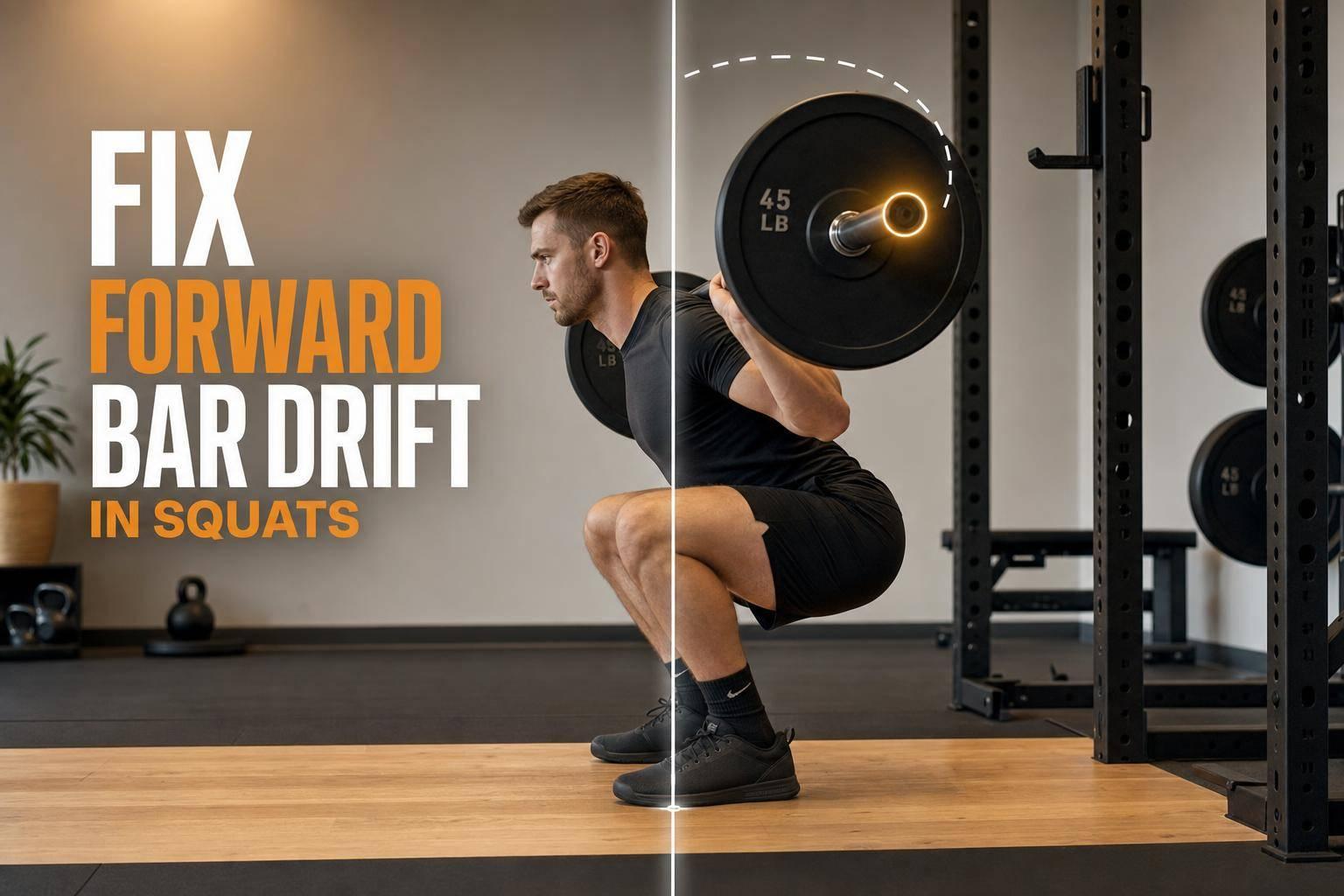
Fix forward bar drift in squats
If the bar drifts toward your toes, your squat gets harder, slower, and rougher on your lower back. The fix is usually not “try harder.” It’s finding the first thing that breaks down: your ankles, your brace, your hip-chest timing, or your bar setup.
Here’s the short version:
- Bar path should stay over your midfoot
- Heel lift often points to limited ankle motion
- Chest dropping or hips popping up first often points to weak bracing or quad limits
- Bar roll or elbow flare often points to a loose upper back or off bar placement
- Side-view video is the fastest way to spot where the drift starts
A few numbers stand out:
- Forward-leaning squats can create up to 3x more disc compression than a more upright squat
- Lifters with poor bar-path consistency can show 8%–12% lower mean velocity at the same load
- In low-bar squats, torso lean often sits around 30°–45°, but past that, the bar may be getting too far in front
If I wanted to fix this fast, I’d do 3 things:
- Film from the side
- Find the first frame where the bar moves in front of midfoot
- Match that moment to one fix: ankle work, bracing work, or upper-back setup
That’s the whole job: find the first fault, fix that first fault, then re-check the bar path.
Reasons Why Your Bar Path Travels Forward In the Squat
How to find the cause of your forward bar drift
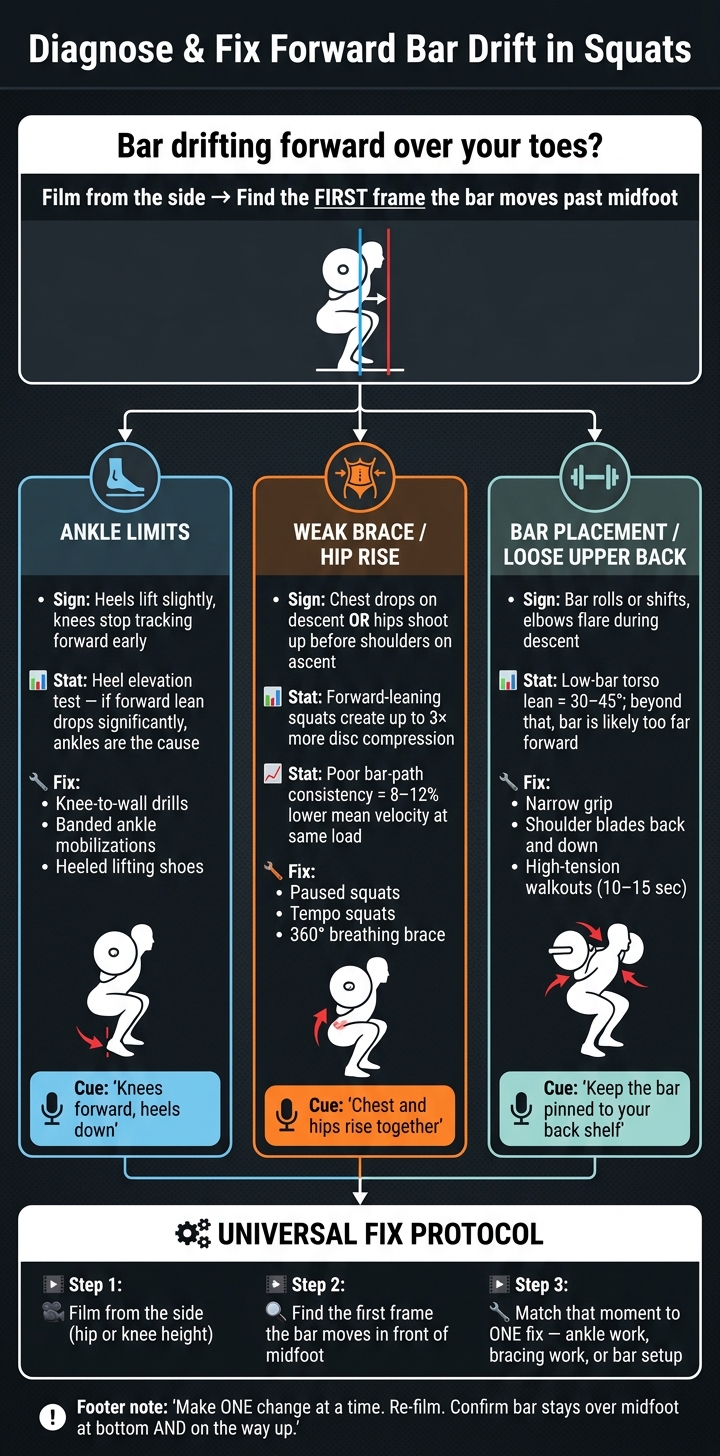
How to Diagnose & Fix Forward Bar Drift in Squats
Forward bar drift doesn’t come from just one issue. That’s why the first job is to figure out when it starts.
Film your squat from the side and watch the bar path against your midfoot. You’re trying to spot the first clear change: does the bar drift at the bottom, during the transition, or partway up? That first breakdown point tells you which fix to try first.
Ankle limits and foot pressure shifting to the toes
When ankle motion is the problem, the pattern usually looks pretty clear. Your knees stop moving forward too soon, so your torso has to fold more to make up for it. Then the bar moves over your toes instead of staying over the midfoot.
Watch your heels closely. Even a slight heel lift can slip past you on a normal-speed video, but it often points to limited ankle dorsiflexion, not just bad cueing.
A simple way to check: elevate your heels and squat again. If your forward lean drops a lot, limited ankle dorsiflexion is probably the main cause [1].
If ankle motion isn’t the limiter, shift your attention to trunk position and how the hips move out of the bottom.
Weak bracing, chest drop, or hips shooting up first
This set of issues comes down to timing and torso control.
If your chest drops as you descend, or your hips shoot up faster than your shoulders out of the hole, the squat starts to look like a good morning. When that happens, the bar usually drifts forward too [2][3].
A paused squat can help here. If your trunk caves during the pause, your bracing pattern probably wasn’t solid to begin with [2].
It helps to notice the exact order of the breakdown:
- If your upper back rounds before the bar leaves the hole, bracing is likely the main issue.
- If your hips jump up first, your quads are usually the limiter.
Poor bar placement or a loose upper back
Sometimes the problem isn’t ankle motion or bracing. It’s the bar setup itself.
If the bar rolls, shifts during the rep, or your elbows drift, your upper back may not be giving the bar a stable shelf. When the upper back is loose, the bar can pull your torso forward instead of staying locked in place.
Bar placement matters too. High-bar squats need a more upright torso. Low-bar squats usually come with about a 30–45 degree torso lean so the bar stays over the midfoot [2][1]. If your bar position doesn’t match your squat style, you’ll often see the bar drift as your body tries to rebalance.
Once you spot the pattern, you can match it to the fix in the next section.
Fix each cause with the right cues and drills
Match the fix to the first point where the bar starts to drift. That first breakdown point tells you which cue and drill to use.
For ankle limits: work on dorsiflexion and keep pressure through the midfoot
Use "Knees forward, heels down" and "keep pressure through the midfoot." Those cues help when limited dorsiflexion shifts pressure away from the center of the foot.
A simple fix is knee-to-wall work to get enough dorsiflexion back so pressure stays centered over the midfoot. You can also add banded ankle mobilizations to your warm-up.
If you need to change your setup, heeled lifting shoes are the most direct option. A slightly wider stance with some toe-out can also give your hips and ankles more room to move.
For bracing and hip rise: lock the torso angle and hips and chest rise together
If your hips move before your chest, the bar usually gets pushed forward with them. The fix is to make the ascent one coordinated push, not two separate motions.
Before you descend, build your brace. Inhale into your abdomen and sides to create 360-degree pressure, then stack your ribs over your hips. Keep that pressure through the full rep.
On the way up, use these cues:
- "chest and hips rise together so the bar stays stacked over midfoot"
- "push the floor away through the midfoot"
Tempo squats and paused squats are good for teaching you to hold your torso angle instead of letting it fold.
"Big breath 360° around your belt, lock it, then ride that pressure all the way down and up." - CueForm [4]
If this only shows up with heavy loads, pull the weight back until you can keep the brace.
For bar position: build a firm back shelf and stop bar roll
You need a stable shelf so the bar stays fixed over the midfoot instead of rolling forward.
Narrow your grip to build upper-back tension. Pull your shoulder blades back and down, and drive your elbows inward. Use "keep the bar pinned to your back shelf" to keep the position locked in, and "pull the bar tight into your upper back" to keep your upper back working through the rep.
If your elbows flare as you descend, that shelf is loosening under load. High-tension walkouts can help here: unrack the bar, brace hard, and stand with it for 10–15 seconds without squatting. That teaches you to lock the upper back before the rep even starts. [2]
Film the rep again and check whether the bar now stays over the midfoot. Then record another set to make sure the drift is gone.
Use video review to confirm the fix is working
After you change a cue or drill, use the same side-view angle to check whether the bar now stays over the midfoot from start to finish. Film from hip or knee height, directly from the side. [2][5]
Focus on three moments:
- the bar over the midfoot on the way down
- the bar over the midfoot at the bottom
- the bar over the midfoot on the way up
The ascent should look a lot like the descent. If it doesn’t, that’s usually where the problem shows up.
Also watch heel contact and hip-chest timing. If your heels lift off the floor, your weight has moved onto your toes. If your hips rise before your chest, your torso is folding forward. A torso lean past 45 degrees from vertical usually means the bar has drifted too far forward. [1]
If the drift is still there, go back to the breakdown point you found earlier.
Track bar path and breakdown points with CueForm AI
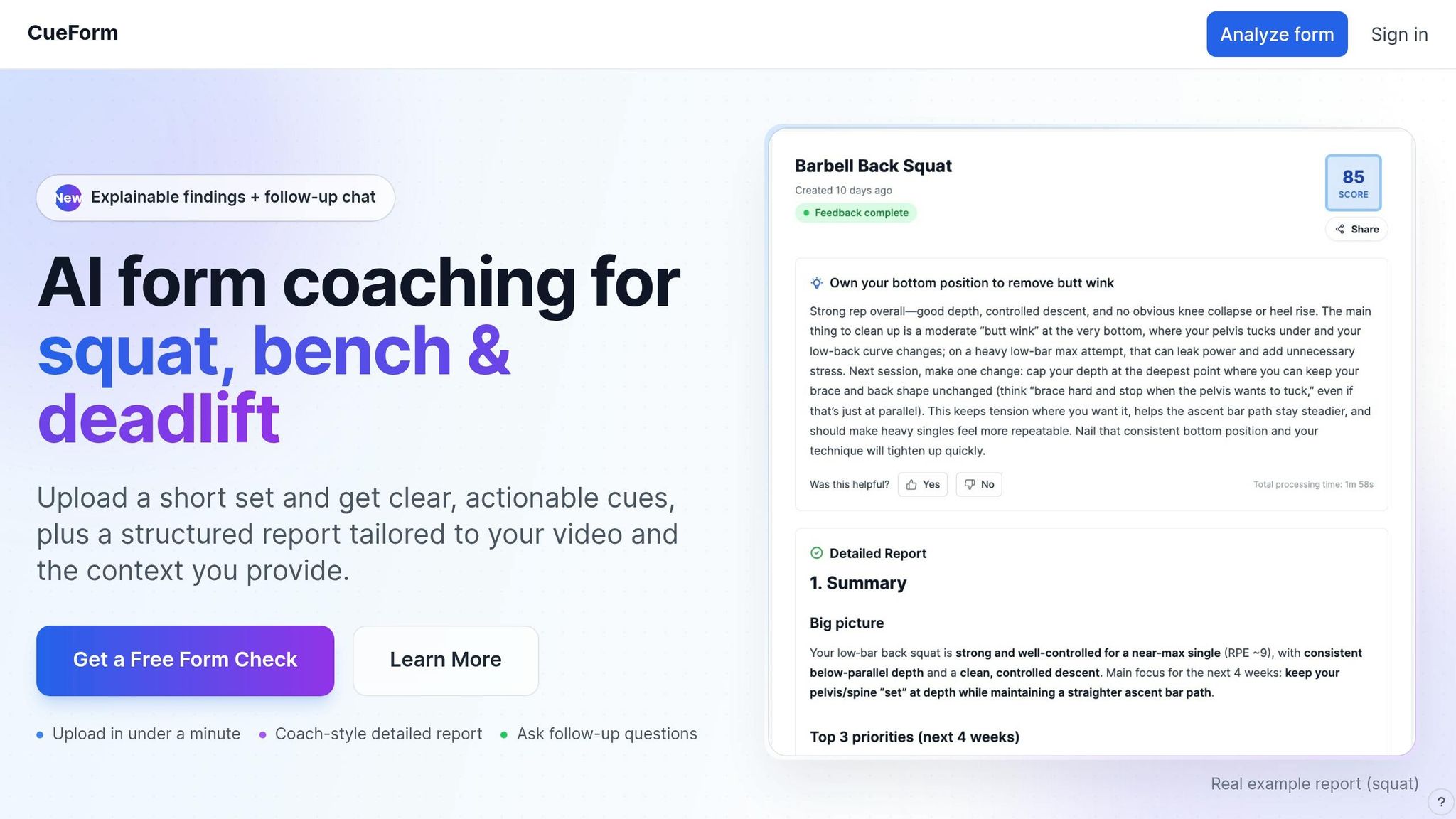
CueForm AI can flag the exact frame where the bar path starts to drift. That makes it much easier to compare a set before and after a cue or drill change and keep your next session focused on the right fix.
Conclusion: bring the bar back over the midfoot
Forward bar drift usually isn't the main problem. It's the result of something that went wrong earlier in the squat: limited ankle motion, weak bracing, hips shooting up too soon, or a bar position that isn't locked in. Once you spot the cause, you know what to work on next.
Tight ankles call for dorsiflexion work. Weak bracing usually gets better with breathing drills and paused squats. If the hips rise too early, back off the load and use a chest-and-hips-together cue. And if the bar feels loose on your back, build a tighter upper-back shelf.
From there, keep it simple. Film your squat from the side, find the first frame where the bar starts to drift, tie that moment to the most likely cause, and make one change at a time. Stick with that fix for a few sessions before you tweak anything else.
Check your bar path every session. If the bar stays over the midfoot at the bottom and during the ascent, you're on the right track. If the drift shows up again when the weight gets heavier, lower the load and clean up the pattern before pushing it again.
FAQs
How do I know which fault starts the bar drift?
Watch when the bar drifts. If it happens on the way down, the cause is often poor bar placement, weak bracing, or mobility limits like restricted ankle range of motion.
If it happens on the way up, it more often points to a strength imbalance. For example, weak quads can make the hips shoot up first. It can also mean you're having trouble keeping core tension.
CueForm AI can help analyze your bar path and show where the breakdown starts.
Should I switch to heeled shoes for forward bar drift?
Yes, heeled weightlifting shoes can help with forward bar drift, especially when limited ankle mobility is part of the issue. The raised heel can make it easier to stay balanced over the mid-foot and keep a more upright torso.
But shoes are only one part of the picture. You also need to look at bracing, hip position, and bar placement. CueForm AI can help spot which issue is throwing off your bar path.
When should I lower the weight to fix bar drift?
Drop the weight if your bar path starts drifting, your depth changes without meaning to, something hurts, or each rep feels like a full-on grind.
A lighter load with clean form does more for you than forcing a sloppy set. If your technique falls apart when the weight gets heavy, pull the load back and use front squats or paused squats until you can keep the bar path vertical and steady.