Study: AI Accuracy in Squat Error Detection
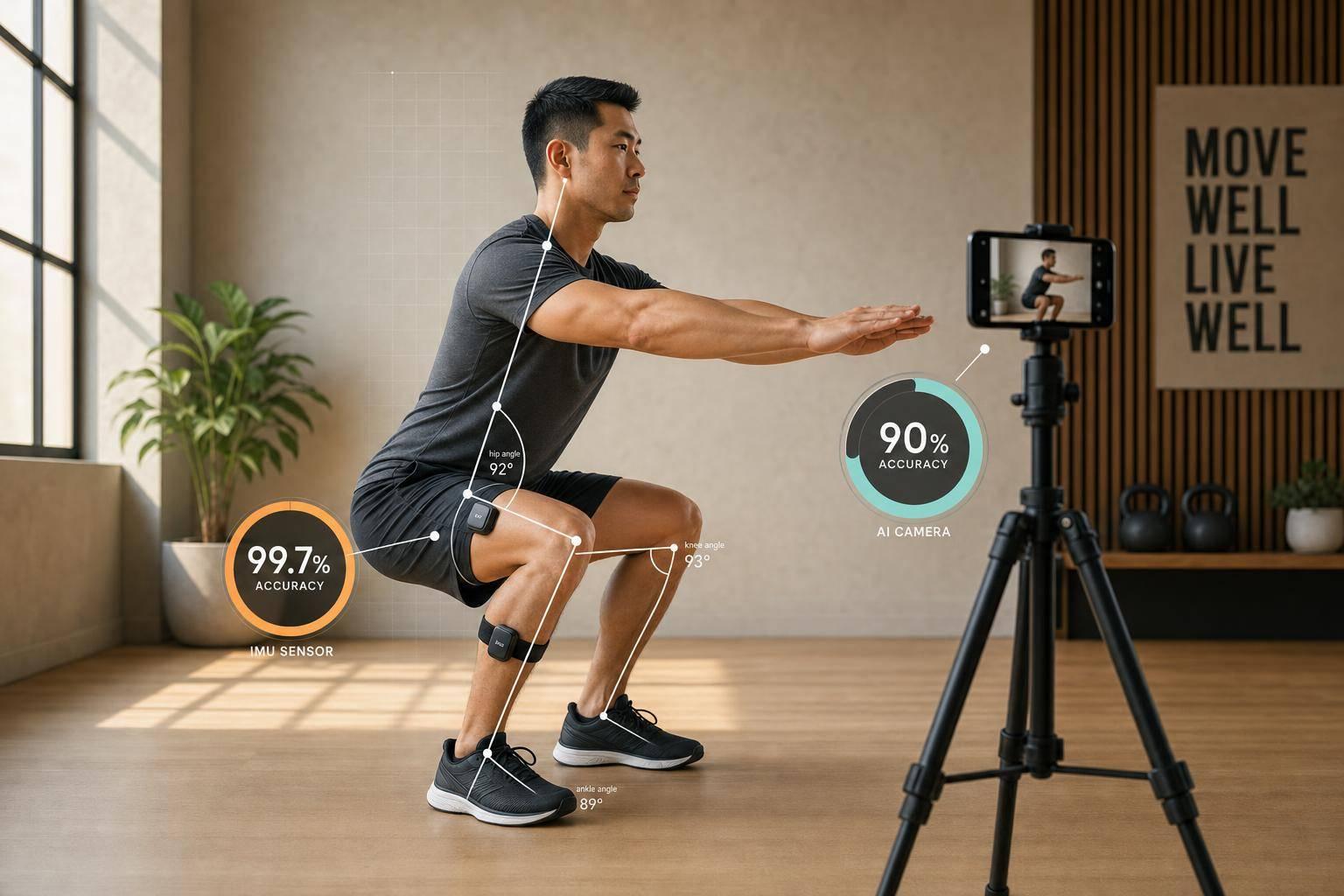
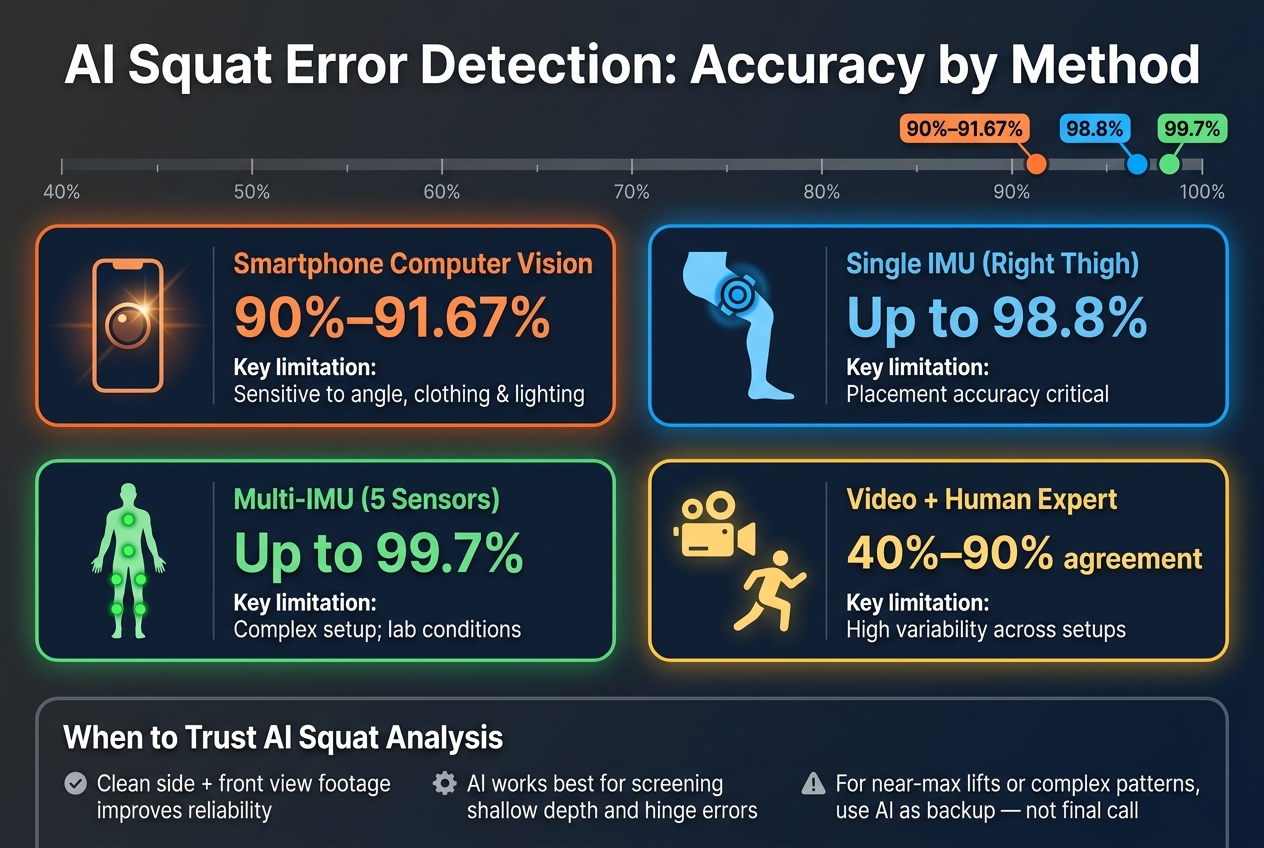
AI can spot some squat faults well in clean setups, but it is not a coach replacement. Based on the studies covered here, smartphone video tools tend to land around 90% to 91.67% accuracy, while IMU sensor setups can reach 98.8% to 99.7% in lab testing. The catch? Those top numbers depend on fixed camera angles, clean views, tight sensor placement, and small study groups.
If I had to boil the article down, I’d say this:
- Video-based AI is easier to use, but it is more likely to slip when lighting, clothing, or camera position is off.
- Wearable sensors score higher, but they add setup work and can miss problems if placement shifts.
- Some squat form mistakes are easier to catch than others, especially shallow depth and clear hinge errors.
- Expert agreement still swings a lot in some studies, from 40% to 90%.
- AI works best as a screening tool, not as the only judge for heavy sets or hard-to-read movement faults.
Here’s the short version: if you want better squat feedback, give the system a side view, front view, full-body frame, and fitted clothing. Clean input usually means cleaner output. But if you’re checking near-max lifts, back position, or mixed compensation patterns like good morning squats, I’d treat AI as helpful backup, not the final call.
| Method | Reported result | Main issue |
|---|---|---|
| Smartphone computer vision | 90%–91.67% accuracy | Angle, occlusion, clothing, lighting |
| Single thigh IMU | Up to 98.8% accuracy | Placement still matters |
| Five-sensor IMU | Up to 99.7% accuracy | More setup, lab-style testing |
| Video + expert comparison | 40%–90% agreement | Big variation across setups |
Bottom line: the research supports AI for basic squat screening and feedback, but not for making every coaching call on its own.
AI Squat Error Detection: Accuracy by Method
Creating Your Own AI Fitness Trainer: Analyzing Squats with MediaPipe

How Researchers Test AI Squat Error Detection
After defining the metrics, the next step is the data collection setup behind them. Researchers test AI squat analysis in either controlled lab settings with standardized camera placement and expert observers, or in uncontrolled gym settings where people record themselves in mixed indoor spaces. Those setup choices shape the results that come next.
Camera Video, Pose Estimation, and Wearable Sensor Setups
Most studies use a smartphone or RGB camera with pose estimation tools such as MediaPipe to track joint coordinates. In many side-view setups, the camera sits about 3–5 feet high and 3–10 feet away [1][4].
Another route is wearable IMUs, which are small motion sensors attached to the body. IMUs take camera angle out of the equation, but they can drift or slip during heavy lifts [1][4]. A 2025 study in Computers in Biology and Medicine tested both a five-sensor IMU array and a single sensor on the right thigh. It reported accuracies of 0.997 and 0.988, respectively [3].
Reference Standards and Labeled Datasets
AI output has to be checked against something. And when that benchmark changes, the reported accuracy changes too. Researchers usually rely on three reference standards.
The most common one is human expert labeling. In this setup, coaches or physiotherapists sort movements into levels such as "good", "moderate", or "poor." A March 2024 study used two experts with more than 30 years of experience to validate Hidden Markov Model outputs from smartphone recordings [4].
A second standard uses established clinical guidelines, most often the NASM framework. That framework defines error categories such as knee valgus, knee varus, low back arching, and low back rounding [3].
A third option builds biomechanical baselines from a lifter's own unloaded squat, then flags changes once heavier loads are added [4].
Metrics Compared Across Studies
| Study Method | Sample Size | Exercise Focus | Reported Result | Main Limitation |
|---|---|---|---|---|
| IMU + Deep Learning (CNN-GRU) [3] | 20 athletes | 5 NASM squat error classes | Accuracy: 0.997 | Lab-controlled sensor placement |
| Smartphone Video + Hidden Markov Models [4] | 10 volunteers (90 repetitions) | Back squat at 0%, 50%, and 75% load | Expert agreement: 40–90% | Small sample; sagittal plane only |
| MediaPipe + Linear Regression [1] | 35 subjects (344 samples) | Standard, shallow, and "Good Morning" squats | Accuracy: 91.67% | Loose clothing distorts 2D joint perception |
| Smartphone ML - Single-Leg Squat [3] | Dataset size not specified | Single-leg squat quality | Accuracy: 0.84; F1-score: 0.85; AUC: 0.92 | Frontal view only; three quality levels |
There’s a clear tradeoff here. IMU-based studies can post very high accuracy, but they depend on exact sensor placement and ask the lifter to wear extra gear. Camera-based studies are non-invasive and easier to use in a gym, but they’re more sensitive to angle, distance, and even clothing choice [1][3][4]. Those differences matter because they shape the accuracy results discussed next.
What the Research Says About AI Accuracy
AI spots squat errors pretty well in controlled setups. But once the visual feed or sensor data gets messy, accuracy slips.
Computer Vision and Smartphone Results
Camera-based systems using MediaPipe have reported 90% to 91.67% accuracy for squat error detection [1]. In one study, the model correctly flagged every "good morning" squat. But it had more trouble with shallow squats, showing a 23.68% false-pass rate because the result was sensitive to joint-angle estimates [1].
The geometric-statistical model beat both LSTM and VGG-16 [1]. That difference stands out most when the camera angle changes or when depth is harder to judge. In plain terms, the system does best when the view stays clean and consistent.
IMU and Wearable Sensor Results
Wearable sensors tend to score higher. A CNN-GRU hybrid model trained on NASM squat error categories reached 99.7% accuracy with a five-sensor IMU array. Even a single IMU on the right thigh reached 98.8% accuracy [3].
That sounds strong, and it is. But there's a catch: those results depend on placing the sensors the right way, every time. If placement shifts, performance can drop, which the next section digs into.
Where AI Performs Well and Where It Misses Errors
Across studies, AI works best when the movement category is clearly defined and the setup is controlled. It misses more often when lighting, clothing, camera angle, or sensor placement adds noise. That's the pattern again and again: clean input in, better output out.
| Technology Type | Typical Performance Range | Notes |
|---|---|---|
| Computer Vision (Smartphone) | 90%–91.67% [1] | Sensitive to loose clothing, poor lighting, and occlusion |
| Single IMU (Right Thigh) | Up to 98.8% [3] | Practical for daily training; may miss upper-body faults |
| Multi-IMU Setup | Up to 99.7% [3] | High accuracy; setup complexity limits real-world use |
| Video/HMM | 40%–90% agreement [4] | Variable; weakest when angle and distance change |
The next section explains why these numbers drop outside controlled setups.
Limits of the Evidence and Training Constraints
These scores come from tight lab setups, not from what you’ll see in most commercial gyms. And that gap matters.
The biggest weak spots are camera position, occlusion, and clothing.
Camera Angle, Distance, Occlusion, and Gym Environment
In lab testing, the setup is often very specific. One study placed the camera about 3.3 feet (1 meter) off the ground and around 16 feet (5 meters) from the background, with the camera lined up square to the side view [4]. That’s neat and controlled. It’s also hard to copy in a busy gym with a squat rack, mirrors, benches, and people moving through the frame.
Real gyms add a lot of visual noise. Power rack uprights, safety pins, and loaded plates often block the camera’s view of key landmarks, especially the hip and ankle [4]. Then there’s the squat itself: at the bottom position, the body can block its own joints, which makes pose estimates drift away from the true joint position [1]. Even clothing can throw things off. Loose shorts or baggy layers can shift the estimated hip position enough to make a shallow squat look deep.
Sensor Placement, Calibration, and Sample Size Limits
IMU results can look strong on paper. One setup reached 99.7% accuracy with five sensors [3]. But that number came from only 20 athletes in a controlled setting. A 2024 study with 10 male volunteers found AI-human agreement ranged from 40% to 90% [4]. That’s a pretty wide spread, and neither sample looks much like the mix of body types, skill levels, and movement habits you’d get in a public gym.
Placement matters too. A single IMU on the right thigh can still hit 98.8% accuracy [3], which sounds great. But some of the highest-scoring models also depend on a clean baseline recording, such as an unweighted squat, before they can flag changes under load with any consistency [4]. In plain English: if the setup is off, the output can be off too.
Setup Trade-Offs by Type
These limits create some clear trade-offs between ease of use and performance.
| Setup Type | Ease of Use | Accuracy Tendency | Sensitivity to gym conditions | Best use case |
|---|---|---|---|---|
| Front-view smartphone | High | Moderate | High (perspective distortion) | Knee valgus, stance width [3] |
| Side-view smartphone | Moderate | Moderate to High | High (occlusion, lighting) | Squat depth, bar path, back angle [4] |
| Multi-IMU (5 sensors) | Low | Very High | Low | Joint angles, velocity, NASM error categories [3] |
| Single-Thigh IMU | High | High | Low | Squat depth, rep count [3] |
So the pattern is pretty simple. Smartphone setups are easier, but they’re more exposed to gym chaos. IMU setups tend to hold up better, but they ask more from the user in terms of placement and setup time.
These trade-offs lead directly into the practical guidance that follows.
What These Findings Mean for Lifters and Coaches
Best Practices for More Reliable AI Squat Analysis
For lifters, the takeaway is pretty simple: better input leads to better AI feedback.
If the video is messy, the analysis can be messy too. Reliable squat analysis starts with clean footage:
- A side view to check depth and bar path
- A front view to check knee tracking
- A full-body frame
- Fitted clothing
Loose clothing can throw off silhouette-based depth estimates.
This setup matters most when you're judging depth and knee motion from the front. AI does best with clear, easy-to-spot issues like shallow depth and obvious hinge-pattern breakdowns. But once the movement gets more layered, things get less clear. For compensatory patterns, agreement between AI and human experts ranges from 40% to 90%, so those calls are worth a second look [4].
How CueForm AI Fits the Research

In day-to-day coaching, these findings line up well with video-based tools that rely on clear squat footage. CueForm AI uses the same basic idea the studies point to: cleaner footage leads to more reliable squat feedback.
That matters because AI can spot small joint shifts that are easy to miss with the naked eye [4]. On top of that, real-time feedback can help improve squat technique [2].
Conclusion: What the Evidence Supports Today
Right now, AI squat analysis makes the most sense as a screening tool. It works best when the video is solid and a coach or lifter uses some judgment.
For near-max loads or more layered movement compensations, AI is better used as a second set of eyes alongside a coach's review [4].
FAQs
How accurate is AI for squat form checks in real gyms?
Research suggests AI works very well for squat form analysis, with modern deep learning models often reaching 90% to 99% accuracy.
By using pose estimation to track joint mechanics and barbell path, these tools can spot subtle errors that human visual observation may miss.
Which squat mistakes does AI catch best?
AI does its best work with squat mistakes it can measure in a clear way, especially changes in knee, torso, and back angles. By tracking skeletal keypoints and joint positions, it can also spot shifts in limb position and barbell path that are easy to miss with the naked eye.
For example, it can reliably monitor knee joint angles to assess proper biomechanics.
How should I record my squat for better AI feedback?
Record your squat from the side view (sagittal plane). From this angle, CueForm AI can see how your hips, knees, and back move through each rep, which helps it track your form and measure joint angles with better accuracy.
Keep your entire body in frame for the full movement, and make sure nothing blocks the camera’s view. A clean setup gives CueForm AI a better read on your squat, so the technique cues it gives you are more precise and personal.